
 Facebook
 Google
 GitHub
 Linkedin
Discrete Semiconductor Devices and Circuits
Bipolar Junction Transistor (BJT) theory
28 questions By Tony R. Kuphaldt
-
Question 25 of 28
Based on these DC continuity tester indications, what type of transistor is this, PNP or NPN?
- Resistance with negative test lead on pin 1, positive test lead on pin 2: no continuity
- Resistance with negative test lead on pin 1, positive test lead on pin 3: no continuity
- Resistance with negative test lead on pin 2, positive test lead on pin 1: no continuity
- Resistance with negative test lead on pin 2, positive test lead on pin 3: no continuity
- Resistance with negative test lead on pin 3, positive test lead on pin 1: continuity
- Resistance with negative test lead on pin 3, positive test lead on pin 2: continuity
Also, to the best of your ability, identify the transistor’s three terminals (emitter, base, and collector).
Reveal answerThis is a PNP transistor. Pin 3 is the base, and pins 1 and 2 are emitter/collector or collector/emitter (can’t be sure which).
Notes:Advise your students about the risks of using an analog multimeter (in ohmmeter mode) to test semiconductor components. Some inexpensive analog multimeter designs actually switch the polarity of the test leads when in the ohmmeter mode. In other words, the red test lead actually connects to the negative side of the meter’s internal battery, while the black test lead connects to the positive side of the internal battery! If you are used to associating red with positive and black with negative, this switch will be quite a surprise.
Ask your students: what effect would a switch in polarity such as the one just described have on the determination of a transistor’s identity? What if the person thought their meter’s red lead was positive and the black lead negative, when in fact it was just the opposite? Would this affect their ability to accurately identify the transistor’s terminals? Why or why not?
-
Question 26 of 28
Many digital multimeters have a “diode check” range that allows the user to measure the forward voltage drop of a PN junction:
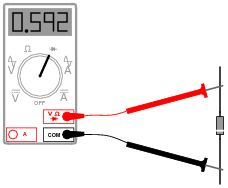
When using a multimeter with this feature to identify the terminals of a bipolar junction transistor, the forward voltage drop indication is necessary to distinguish the collector terminal from the emitter terminal. Explain how this distinction is made on the basis of the forward voltage measurement, and also explain why this is.
Reveal answerThe emitter-base junction has a slightly greater forward voltage drop than the base-collector junction. I’ll let you explain why!
Notes:I am surprised how many textbooks do not explain how to identify BJT terminals using a multimeter (especially a multimeter with the “diode check” function). This is a very important skill for technicians to have, as they will often be faced with transistor terminal identification in the absence of datasheets or other graphical references to device terminals.
-
Question 27 of 28
Identify the terminals on this BJT, and also the type of BJT it is (NPN or PNP):
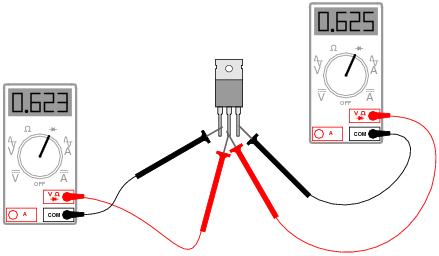
Reveal answer
Notes:I have found this “diode check” multimeter technique to be very successful for identifying BJT terminals.







What surprises me is the following: I did not see any mentioning of the most important BJT parameter: Transconductance gm.
(Instead, you are stating that the beta-value would be a very important parameter - which is NOT the case!).
Like some other low-level electronic books and papers you treat the BJT as a cittent-controlled device - this is simply wrong.
There is not a single proof that the BJT would be a CCCS !
However, there are many theoretical explanations, measurements and observable facts which clearly show that the BJT is - of course - voltage-controlled. Who can deny it ? With which arguments? Ic=beta x Ib is just a formula - a misinterpretation of Ib=Ic/beta.