
 Facebook
 Google
 GitHub
 Linkedin
Discrete Semiconductor Devices and Circuits
Class A BJT Amplifiers
62 questions By Tony R. Kuphaldt
-
Question 34 of 62
One major different between a common-emitter amplifier configuration and a common-collector amplifier configuration is a principle called negative feedback, where changes in output voltage “feed back” to influence the amplifier’s input signal, which in turn influences the output voltage again. Common-collector amplifier circuits have large amounts of negative feedback inherent to their design.
The absence or presence of negative feedback in an amplifier circuit has profound effects on voltage gain (AV). Compare the relative voltage gains of the following amplifiers:

At first, the low voltage gain of the common-collector amplifier may appear to be a disadvantage of that circuit design. However, there is one major benefit relevant to the common-collector amplifier’s voltage gain, being a direct result of negative feedback. What is this advantage?
Reveal answerAlthough the common-collector amplifier has a very low voltage gain (AV = 1), that gain is absolutely stable over a wide range of operating conditions and component selection.
Notes:Discuss with your students the many factors that can influence voltage gain in a common-emitter amplifier circuit, and then compare that relative instability with the rock-solid stability of the common-collector amplifier’s voltage gain. What benefit is it to a circuit designer to have a stable voltage gain from a particular amplifier design?
-
Question 35 of 62
One way to reap the advantages of negative feedback enjoyed in common-collector amplifier circuits, in a common-emitter amplifier, is to add components that intentionally “feed back” some of the output signal to the transistor’s input in a degenerative fashion:
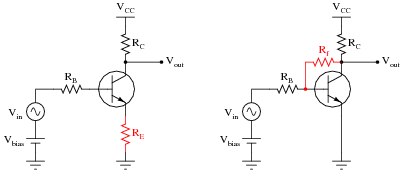
Explain what the term negative (or degenerative) means with reference to feedback, and explain how each of these techniques works to produce this type of feedback. Also, explain one disadvantage of applying negative feedback to a common-emitter amplifier circuit.
Reveal answer“Negative” or “degenerative” feedback means that any change on the output gets “fed back” in such a way that it tries to cancel itself.
The use of an emitter resistor (RE) simply makes the amplifier circuit look more like a common-collector configuration, and the feedback functions in the same way. The use of a “feedback” resistor (Rf) takes advantage of the common-emitter’s inverting nature, the output signal being 180o out of phase with the input.
Applying negative feedback to a common-emitter amplifier has the effect of decreasing its voltage gain.
Notes:Negative feedback is a vitally important principle for electronics students to understand. It is the basis of almost every type of control system, and it makes standardized amplifier design possible. Take as much time as necessary to discuss this with your students, and to make sure they understand how and why negative feedback works as it does.
Be sure to discuss the twin effects of negative feedback: increased voltage gain stability, and decreased voltage gain. Ask your students why anyone would want their amplifier circuit to suffer a loss of voltage gain just for the sake of gain stability. Why is the stability if voltage gain important?
-
Question 36 of 62
Sometimes a feedback network is purposely placed in an amplifier circuit, like the Rf-Cf combination shown in the following schematic:
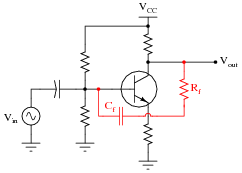
Explain what will happen to the amplifier circuit’s performance if either one of the components in this feedback network fails open.
Reveal answerThe amplifier’s gain will increase, possibly to the point of distorting the signal.
Notes:The purpose of this question is to approach the domain of circuit troubleshooting from a perspective of knowing what the fault is, rather than only knowing what the symptoms are. Although this is not necessarily a realistic perspective, it helps students build the foundational knowledge necessary to diagnose a faulted circuit from empirical data. Questions such as this should be followed (eventually) by other questions asking students to identify likely faults based on measurements.


