
 Facebook
 Google
 GitHub
 Linkedin
AC Electric Circuits
Delta and Wye 3-Phase Circuits
15 questions By Tony R. Kuphaldt
-
Question 10 of 15
A common three-phase source connection scheme is the Delta high-leg or Four-wire Delta, where each phase coil outputs 240 volts:

Identify the different voltages obtained from this coil configuration, and which connection points each voltage is measured between.
Reveal answerVAB = 240 volts VBC = 240 volts VAC = 240 volts
VAN = 120 volts VBN = 208 volts VCN = 120 volts
Notes:The usefulness of this connection scheme should be clearly evident: three different voltage levels may be accessed for use in powering circuits. Usually, the coils shown are secondary windings of three different transformers, the primary windings connected to a set of three-phase high voltage power lines. In many cases, a heavier-duty transformer is used for coil AC than for coils AB or BC due to the number of 120 volt loads.
-
Question 11 of 15
Identify the primary-secondary connection configuration of these three power transformers (i.e. Y-Y, Y-Delta, Delta-Y, etc.):

Reveal answerDelta-Y
Notes:Three-phase power transformers are somewhat rare compared to combinations of multiple single-phase transformers. Questions such as this are really nothing more than pattern-recognition exercises, but like all skills this does not come naturally to all people, and practice improves it!
-
Question 12 of 15
An electrical lineman is connecting three single-phase transformers in a Y(primary)-Y(secondary) configuration, for power service to a business. Draw the connecting wires necessary between the transformer windings, and between the transformer terminals and the lines:
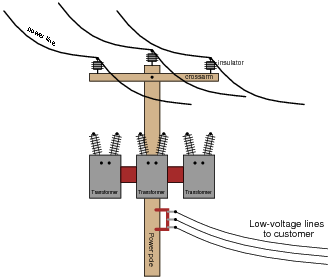
Note: fuses have been omitted from this illustration, for simplicity.
Reveal answer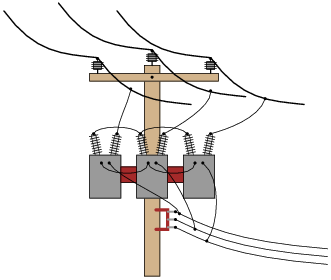
Of course, this is not the only way these three transformers could be connected in a Y-Y configuration.
Notes:Being that pole-mounted power distribution transformers are exposed for anyone to look at, they provide an excellent opportunity for students to practice identifying three-phase connections. If there are any such transformer configurations located near your campus, it would be an interesting field exercise to bring students there (or send them there on “field research”!) to identify the connections. Photographs of transformer connections may also be used in the classroom to provide practical examples of this concept.
Related Tools:
- Electrical Conduction in Semiconductors
- Performance-Based Assessments for Digital Circuit Competencies





Great information I’m sure, but the answers with diagrams can’t be read. They are blurry if you try to enlarge them and they aren’t on the PDF. Please resolve at your convenience.