Facebook
 Google
 GitHub
 Linkedin
Digital Circuits
Electromechanical Relay Logic
19 questions By Tony R. Kuphaldt
-
Question 13 of 19
Complete the truth table for the following relay logic circuit, and then complete a second truth table for the same circuit with relay coil CR2 failed open:
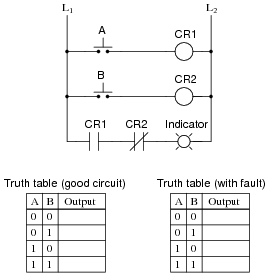
Explain why the truth table will be modified as a result of the fault.
Reveal answer
If you thought that the “faulted” truth table would be all 0’s, you probably thought I said relay contact CR2 failed open. The fault I proposed was relay CR2 coil failed open.
Notes:The purpose of this question is to approach the domain of circuit troubleshooting from a perspective of knowing what the fault is, rather than only knowing what the symptoms are. Although this is not necessarily a realistic perspective, it helps students build the foundational knowledge necessary to diagnose a faulted circuit from empirical data. Questions such as this should be followed (eventually) by other questions asking students to identify likely faults based on measurements.
-
Question 14 of 19
Predict how the operation of this motor control circuit will be affected as a result of the following faults. Consider each fault independently (i.e. one at a time, no multiple faults):

- “Stop” pushbutton switch fails open:
- Relay contact CR1-1 fails open:
- Relay contact CR1-2 fails open:
- Relay coil CR1 fails open:
For each of these conditions, explain why the resulting effects will occur.
Reveal answer- “Stop” pushbutton switch fails open: Motor cannot start, lamp never energizes.
- Relay contact CR1-1 fails open: Motor starts and lamp energizes when “Start” button is pressed, but both immediately de-energize when it is released.
- Relay contact CR1-2 fails open: “Motor run” lamp turns on and off as expected, but the motor itself never runs.
- Relay coil CR1 fails open: Motor cannot start, lamp never energizes.
Notes:The purpose of this question is to approach the domain of circuit troubleshooting from a perspective of knowing what the fault is, rather than only knowing what the symptoms are. Although this is not necessarily a realistic perspective, it helps students build the foundational knowledge necessary to diagnose a faulted circuit from empirical data. Questions such as this should be followed (eventually) by other questions asking students to identify likely faults based on measurements.
-
Question 15 of 19
Suppose you come across a relay that is said to have “Form C” contacts. What does this phrase mean? And, is there such a thing as either “Form A” or “Form B” contacts?
Reveal answer“Form C” is just another way of saying “SPDT” with regard to switch or relay contacts.
Notes:When I first heard of a switch having “Form C” contacts, I had absolutely no idea what it meant. I was quite familiar with “single-pull, double-throw,” but not this new term. Different industries often use different terms for describing the same things. Your students should be made aware that there is a tendency for people to become “isolated” within their respective industries or fields of expertise, to the point where they may be unaware of alternative terms for the same things (Form-C versus SPST is a good example of this). Your students may even find themselves misjudged by others for not knowing the peculiar and specialized terms used within certain industries, when they first obtain employment. In many ways it is akin to the misunderstandings arising when different cultures meet: people have the general tendency to think their way of doing things is the only way. Bridging such cultural divides requires patience, humility, and tact.