Facebook
 Google
 GitHub
 Linkedin
AC Electric Circuits
Series-Parallel Combination AC Circuits
26 questions By Tony R. Kuphaldt
-
Question 16 of 26
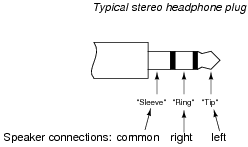
Stereo (two-speaker) headphones typically use a plug with three contact points to connect the speakers to the audio amplifier. The three contact points are designated as “tip,” “ring,” and “sleeve” for reasons that are obvious upon inspection, and as such the plug is commonly referred to as a “TRS” plug. Both speakers in the headphone unit share a common connection (at the “sleeve” contact), with the “tip” and “ring” contacts providing connection to left and right speakers, respectively:
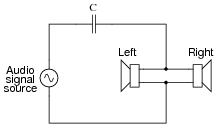
Draw a picture showing how connections would be made to the plug’s contact points to form this circuit:
Reveal answer
Notes:This question challenges students to determine what “common” means, in relation to the speaker connections. Also, it requires that they translate the nice, clean schematic diagram into a real-world illustration, which is a difficult task for some (but well worth the time to practice!).
-
Question 17 of 26
Stereo (two-speaker) headphones typically use a plug with three contact points to connect the speakers to the audio amplifier. The three contact points are designated as “tip,” “ring,” and “sleeve” for reasons that are obvious upon inspection, and as such the plug is commonly referred to as a “TRS” plug. Both speakers in the headphone unit share a common connection (at the “sleeve” contact), with the “tip” and “ring” contacts providing connection to left and right speakers, respectively:
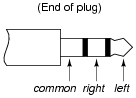
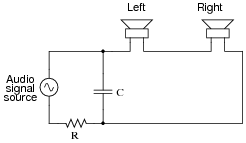
Draw a picture showing how connections would be made to the plug’s contact points to form this circuit:
Reveal answer
Notes:This question challenges students to determine what “common” means, in relation to the speaker connections. Also, it requires that they translate the nice, clean schematic diagram into a real-world illustration, which is a difficult task for some (but well worth the time to practice!).
-
Question 18 of 26
Convert this series-parallel combination circuit into an equivalent simple-parallel circuit (all components connected in parallel with each other, with nothing in series), and also calculate the circuit’s total impedance:
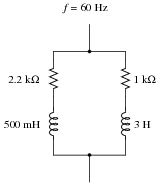
Reveal answer
Ztotal = 963.0 Ω
Challenge question: from the simple-parallel equivalent circuit shown here, can you generate an equivalent circuit that is simple-series? In other words, can you calculate the proper values of R and L, that when connected in series, will have the same total impedance as this circuit?
Notes:Fundamentally, this question asks students to generate an equivalent parallel R-X circuit from a given series R-X circuit. In this particular circuit, there are two series-connected R-X branches, resulting in an equivalent parallel circuit with four branches.
Calculating the circuit’s total impedance as a scalar figure involves simplifying the circuit once more into two components: a resistance and a reactance.


Related Tools:
- Algebraic Substitution for Electric Circuits
- Performance-Based Assessments for Basic Electricity Competencies