Facebook
 Google
 GitHub
 Linkedin
AC Electric Circuits
Series-Parallel Combination AC Circuits
26 questions By Tony R. Kuphaldt
-
Question 22 of 26
Calculate the total impedance of this series network of impedances, in complex form:

Reveal answerZtotal = 1.526 kΩ ∠ 9.336o
Follow-up question: overall, does this network behave more like a capacitor, an inductor, or a resistor? Explain your answer.
Notes:Students should find series impedance calculations very similar to series (DC) resistance calculations, the only significant difference being the use of complex instead of scalar numbers.
-
Question 23 of 26
Calculate the total impedance of this parallel network of impedances, in complex form:
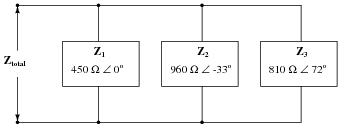
Reveal answerZtotal = 283.3 Ω ∠ 9.899o
Follow-up question: overall, does this network behave more like a capacitor, an inductor, or a resistor? Explain your answer.
Notes:Students should find parallel impedance calculations very similar to parallel (DC) resistance calculations, the only significant difference being the use of complex instead of scalar numbers. This makes parallel impedance calculations difficult, no doubt about it. Attaining a solution for this problem will involve a lot of arithmetic, with lots of room for calculation error.
-
Question 24 of 26
Calculate the total impedance of this series-parallel network of impedances, in complex form:
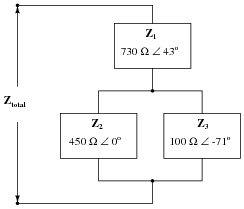
Reveal answerZtotal = 715.1 Ω ∠ 35.8o
Follow-up question: overall, does this network behave more like a capacitor, an inductor, or a resistor? Explain your answer.
Notes:Students should find parallel impedance calculations very similar to parallel (DC) resistance calculations, the only significant difference being the use of complex instead of scalar numbers. This makes parallel impedance calculations difficult, no doubt about it. Attaining a solution for this problem will involve a lot of arithmetic, with lots of room for calculation error.
Related Tools:
- Algebraic Substitution for Electric Circuits
- Performance-Based Assessments for Basic Electricity Competencies