Facebook
 Google
 GitHub
 Linkedin
AC Electric Circuits
Series-Parallel Combination AC Circuits
26 questions By Tony R. Kuphaldt
-
Question 10 of 26
Calculate the amount of current through this impedance, and express your answer in both polar and rectangular forms:

Reveal answerI = 545.45 μA ∠ 21o
I = 509.23 μA j195.47 μA
Follow-up question: which of these two forms is more meaningful when comparing against the indication of an AC ammeter? Explain why.
Notes:It is important for your students to realize that the two forms given in the answer are really the same quantity, just expressed differently. If it helps, draw a phasor diagram showing how they are equivalent.
This is really nothing more than an exercise in complex number arithmetic. Have your students present their solution methods on the board for all to see, and discuss how Ohm’s Law and complex number formats (rectangular versus polar) relate to one another in this question.
-
Question 11 of 26
Determine the total impedance of this series-parallel network by first converting it into an equivalent network that is either all-series or all-parallel:
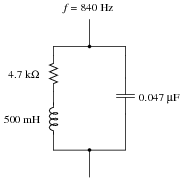
Reveal answerEquivalent parallel resistance and reactances:

Ztotal = 4.433 kΩ
Notes:Although there are other methods of solving for total impedance in a circuit such as this, I want students to become comfortable with series/parallel equivalents as an analysis tool.
-
Question 12 of 26
Determine the voltage dropped between points A and B in this circuit:

Hint: convert the parallel RC sub-network into a series equivalent first.
Reveal answerVAB = 10.491 volts
Notes:Although there are other ways to calculate this voltage drop, it is good for students to learn the method of series-parallel sub-circuit equivalents. If for no other reason, this method has the benefit of requiring less tricky math (no complex numbers needed!).
Have your students explain the procedures they used to find the answer, so that all may benefit from seeing multiple methods of solution and multiple ways of explaining it.

Related Tools:
- Algebraic Substitution for Electric Circuits
- Performance-Based Assessments for Basic Electricity Competencies