
 Facebook
 Google
 GitHub
 Linkedin
Digital Circuits
Shift Registers
22 questions By Tony R. Kuphaldt
-
Question 4 of 22
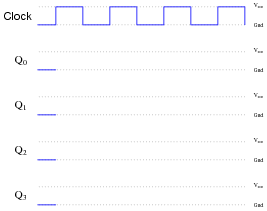
Complete the timing diagram for this circuit, showing propagation delays for all flip-flops (delay times much less than the width of a clock pulse), assuming all Q outputs begin in the low state:

Reveal answer
Notes:This question reviews the principles of D-type flip-flops, timing diagrams, and serves as an introduction to shift registers.
-
Question 5 of 22
What is the definition of a register in the context of digital circuitry? Also, define and compare/contrast what a shift register is.
Reveal answerA “register” is a collection of flip-flops or latches used to store a binary number (several bits). In essence, it is a one-word memory circuit. A “shift register” does the same thing as a register, except that it also has the ability to move that binary word from one place to another.
Notes:Registers are a good way to introduce the basic concepts of solid-state (RAM) memory technology, showing how flip-flop or latch circuits may be used as data storage devices. Be sure to ask your students where they were able to find this information, as it should be very easy for them to research!
-
Question 6 of 22
Explain the difference between serial digital data and parallel digital data.
Reveal answerSerial data is transmitted along one line, one bit at a time; parallel data is transmitted all at once.
Notes:Ask your students of they have ever heard of “serial” and “parallel” ports on personal computers. If time permits, have them examine the two types of ports on the back of a PC, contrasting the number of pins used for each connector.




any one can help me