
 Facebook
 Google
 GitHub
 Linkedin
Network Analysis Techniques
Thevenin’s, Norton’s, and Maximum Power Transfer Theorems
46 questions By Tony R. Kuphaldt
-
Question 46 of 46
Suppose we were planning to use a photovoltaic panel to generate electricity and electrolyze water into hydrogen and oxygen gas:
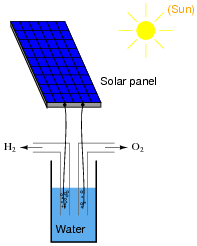
Our goal is to electrolyze as much water as possible, and this means we must maximize the electrolysis cell’s power dissipation. Explain how we could experimentally determine the optimum internal resistance of the electrolysis cell, prior to actually building it, using nothing but the solar panel, a rheostat, and a DMM (digital multimeter).
Reveal answerExperimentally determine what amount load resistance drops exactly one-half of the panel’s open-circuit voltage.
Follow-up question: assuming that the open-circuit voltage of this solar panel were high enough to pose a shock hazard, describe a procedure you might use to safely connect a “test load” to the panel.
Notes:Students should at this point understand the maximum power transfer theorem, and also the concept of a voltage source having a certain amount of internal resistance. The “trick” of this question is, of course, how to determine the panel’s internal resistance. Do not be surprised if a student suggests using the meter to measure the panel’s resistance directly (though this will not work with a real photovoltaic panel).
Regarding the safety-oriented follow-up question, you might want to ask your students what the commonly accepted “shock hazard” voltage level is (30 volts).






I think there is an error in 8th question, Thevenin’s resistance must be 479.53 and not 210.53
There is another mistake in question 39:
“this student’s power source circuit resembles a 3 volt source in series with a 5 kΩ resistance”—should be 2.5 kΩ resistance