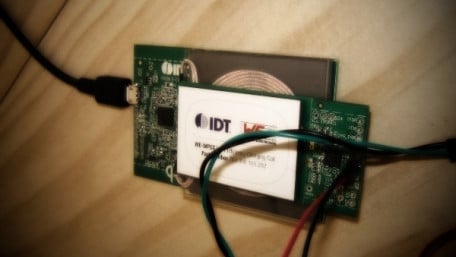
Is IDT’s Tx/Rx wireless power solution suitable for applications that require high-precision analog performance?
Is IDT’s Tx/Rx wireless power solution suitable for applications that require high-precision analog performance?

Part 2 in the “How to Make an EFM8-Based Sound Synthesizer” series.
Part 2 in the “How to Make an EFM8-Based Sound Synthesizer” series.

Part 4 in the “How to Make an Ambient Light Monitor” series
Part 4 in the “How to Make an Ambient Light Monitor” series

Part 2 in the "How to Make an Ambient Light Monitor" Series. Our smart ambient light monitor will need to digitize and…
Part 2 in the "How to Make an Ambient Light Monitor" Series. Our smart ambient light monitor will need to digitize and analyze signals from an optical detector, so it is time to explore the EFM8’s integrated analog-to-digital conversion functionality.

Part 3 in the “How to Make an Ambient Light Monitor” series. The project continues by building an ambient light…
Part 3 in the “How to Make an Ambient Light Monitor” series. The project continues by building an ambient light sensor circuit on a breadboard, digitizing the circuit’s output signals, and interpreting the digitized measurements.

Learn how to use an EFM8 microcontroller to convert current and voltage measurements to digits that can be displayed on…
Learn how to use an EFM8 microcontroller to convert current and voltage measurements to digits that can be displayed on an LCD. We'll discuss a convenient way to report analog-to-digital conversion values that represent current and voltage amplitudes.

Introduction to the Arduino SPI Library with example sketch for the LTC1286 12 Bit ADC and the DAC714 16 bit DAC.
Introduction to the Arduino SPI Library with example sketch for the LTC1286 12 Bit ADC and the DAC714 16 bit DAC.

The LM35 is an ideal temperature sensor for measuring ambient temperature. It provides a linear output proportional to…
The LM35 is an ideal temperature sensor for measuring ambient temperature. It provides a linear output proportional to the temperature, with 0 V corresponding to 0 degrees C and an output voltage change of 10 mV for each degree C change. LM35s are easier to use than thermistors and thermocouples because they are so linear and require no signal conditioning.

The Arduino can input and output analog signals as well as digital signals.
The Arduino can input and output analog signals as well as digital signals.

Communicating serially with the Arduino is easy! Here, we'll show how to take some temperature measurements and then send…
Communicating serially with the Arduino is easy! Here, we'll show how to take some temperature measurements and then send the measurements over the serial link.


 Facebook
 Google
 GitHub
 Linkedin