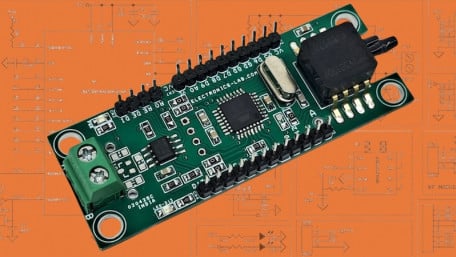
This project brief describes how to build and use an Arduino-compatible interface board that reads an on-board pressure sensor and reports the measurement over…
This project brief describes how to build and use an Arduino-compatible interface board that reads an on-board pressure sensor and reports the measurement over an RS-485 network.

This project brief describes how to build and use an Arduino-compatible interface board that reads a 2-axis thumb…
This project brief describes how to build and use an Arduino-compatible interface board that reads a 2-axis thumb joystick and transmits its position over an RS-485 network.

This project brief describes how to build and use an Arduino-compatible relay interface board that switches a 10 A load…
This project brief describes how to build and use an Arduino-compatible relay interface board that switches a 10 A load over an RS-485 network.

This project brief describes how to build and use a four-channel differential line receiver module for balanced RS-422…
This project brief describes how to build and use a four-channel differential line receiver module for balanced RS-422 and RS-485 data links.

This project brief describes how to implement a four-channel differential line driver module for reliable long-distance…
This project brief describes how to implement a four-channel differential line driver module for reliable long-distance data transmission over balanced twisted-pair lines.

This project brief describes how to assemble an isolated half-bridge IGBT gate driver module built around the…
This project brief describes how to assemble an isolated half-bridge IGBT gate driver module built around the NCD57085DR2G. It features onboard current sensing and overcurrent protection.

To complete this project, we add backlight control and temperature-sensing functionality to the clock we built in the…
To complete this project, we add backlight control and temperature-sensing functionality to the clock we built in the previous installments.
We continue our design of a clock that uses analog ammeters to display time and temperature. In this installment, we…
We continue our design of a clock that uses analog ammeters to display time and temperature. In this installment, we examine the second of the two circuits that enable the timekeeping function.
This project turns old-school analog ammeters into a working clock that can also display the ambient temperature.
This project turns old-school analog ammeters into a working clock that can also display the ambient temperature.

Learn how to turn an ATmega328 microcontroller and an assortment of readily available parts into a dedicated hardware soundboard.
Learn how to turn an ATmega328 microcontroller and an assortment of readily available parts into a dedicated hardware soundboard.

For this project, I built a handheld resistor color code calculator and ohmmeter using the ATmega328 microcontroller and…
For this project, I built a handheld resistor color code calculator and ohmmeter using the ATmega328 microcontroller and a 1.8-inch color LCD display.

Learn how to implement finite-state machines in VHDL by creating a 4-bit binary counter. After compiling, it will run on…
Learn how to implement finite-state machines in VHDL by creating a 4-bit binary counter. After compiling, it will run on an Altera CPLD development board connected to a custom PCB with input switches and an LED display.

In this project, which uses the Arduino IDE, we create and demonstrate a digital drawing pad using an ESP32-based e-paper…
In this project, which uses the Arduino IDE, we create and demonstrate a digital drawing pad using an ESP32-based e-paper display dev board, rotary encoders for drawing control, and an accelerometer for shake detection to initiate an erase.

In this project, we’ll use a Raspberry Pi Pico to build an adjustable clock with an LED display. We’ll then integrate…
In this project, we’ll use a Raspberry Pi Pico to build an adjustable clock with an LED display. We’ll then integrate the clock with a Radio Shack Science Fair Microcomputer Trainer programmed to function as a 7-bit binary counter.

A PIR sensor detects objects to allow a Raspberry Pi Pico running MicroPython code to adjust the frequency of a Science…
A PIR sensor detects objects to allow a Raspberry Pi Pico running MicroPython code to adjust the frequency of a Science Fair electronic oscillator circuit with audio output.

In this project we create an 8-bit arithmetic logic unit (ALU) in the VHDL language and run it on an Altera CPLD…
In this project we create an 8-bit arithmetic logic unit (ALU) in the VHDL language and run it on an Altera CPLD development board connected to a custom PCB with input switches and LED display.

In this hands-on project, we will update a 1980s version of a one-shot (monostable multivibrator) circuit by giving it a…
In this hands-on project, we will update a 1980s version of a one-shot (monostable multivibrator) circuit by giving it a modern, colorful output while also examining the circuit's operation.

Let’s modernize a circuit from a Science Fair 150-in-1 Electronic Project kit using a solderless breadboard, new…
Let’s modernize a circuit from a Science Fair 150-in-1 Electronic Project kit using a solderless breadboard, new electronic components, online EDA tools, and an M5Stack Core microcontroller.

In this project, learn how to use a potentiometer's reading on the M5Stack core to control a servo motor.
In this project, learn how to use a potentiometer's reading on the M5Stack core to control a servo motor.

In this project, learn to create a digitally-controlled oscillator or DCO-based audio synthesizer with an Arduino Nano or…
In this project, learn to create a digitally-controlled oscillator or DCO-based audio synthesizer with an Arduino Nano or an Arduino Uno.


 Facebook
 Google
 GitHub
 Linkedin