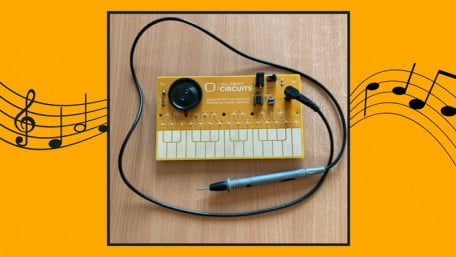
In this project article, we'll use a 555 timer IC to build an iconic musical instrument from the early days of synthesizers.
In this project article, we'll use a 555 timer IC to build an iconic musical instrument from the early days of synthesizers.

In this project article, we’ll create a programmable device that alerts users to changes in ambient light levels. Along…
In this project article, we’ll create a programmable device that alerts users to changes in ambient light levels. Along the way, we’ll learn about astable multivibrators and the Darlington pair.

In this project, we mix the old and the new by integrating present-day BLE technology with a vintage Science Fair computer kit.
In this project, we mix the old and the new by integrating present-day BLE technology with a vintage Science Fair computer kit.

A PIR sensor detects objects to allow a Raspberry Pi Pico running MicroPython code to adjust the frequency of a Science…
A PIR sensor detects objects to allow a Raspberry Pi Pico running MicroPython code to adjust the frequency of a Science Fair electronic oscillator circuit with audio output.

In this hands-on project, we will update a 1980s version of a one-shot (monostable multivibrator) circuit by giving it a…
In this hands-on project, we will update a 1980s version of a one-shot (monostable multivibrator) circuit by giving it a modern, colorful output while also examining the circuit's operation.

In this project, learn to create a digitally-controlled oscillator or DCO-based audio synthesizer with an Arduino Nano or…
In this project, learn to create a digitally-controlled oscillator or DCO-based audio synthesizer with an Arduino Nano or an Arduino Uno.

Tired of using your PC or mobile phone as a signal generator? It’s time to upgrade to a standalone one by making it yourself.
Tired of using your PC or mobile phone as a signal generator? It’s time to upgrade to a standalone one by making it yourself.

In this article, we’ll evaluate different firmware strategies in our pursuit of maximum-frequency analog signal generation.
In this article, we’ll evaluate different firmware strategies in our pursuit of maximum-frequency analog signal generation.

In this article, we’ll develop firmware that will serve as the basis for high-precision, high-speed signal generation.
In this article, we’ll develop firmware that will serve as the basis for high-precision, high-speed signal generation.

In this article, we’ll look at a fairly straightforward circuit that enables a robot or other device to detect sound.
In this article, we’ll look at a fairly straightforward circuit that enables a robot or other device to detect sound.

This project introduces ATmega328P fuse bits and shows how to set them to use an external 16 MHz crystal oscillator.
This project introduces ATmega328P fuse bits and shows how to set them to use an external 16 MHz crystal oscillator.

Nowhere to hide presents this holiday season? No problem! This alarm will sound anytime a loved one tries to get a sneak…
Nowhere to hide presents this holiday season? No problem! This alarm will sound anytime a loved one tries to get a sneak peek at his or her surprise.


Build a 1V octave voltage-controlled oscillator (VCO) module and create your own analogue synth sounds.
Build a 1V octave voltage-controlled oscillator (VCO) module and create your own analogue synth sounds.

Part Three in this three-article series shows you how to generate values for a discrete sinusoid and continuously convert…
Part Three in this three-article series shows you how to generate values for a discrete sinusoid and continuously convert this data into an analog signal without overburdening the CPU.

Part Two in this three-article series explores the SAM4S DAC. We’ll look at hardware configuration, electrical…
Part Two in this three-article series explores the SAM4S DAC. We’ll look at hardware configuration, electrical characteristics, and the application programming interface.

Part One in this three-article series focuses on using the SAM4S timer/counter peripheral to precisely control the…
Part One in this three-article series focuses on using the SAM4S timer/counter peripheral to precisely control the DAC’s sampling rate.

In this article we’ll use the SAM4S Xplained Pro development platform to get some hands-on experience with a PWM DAC.
In this article we’ll use the SAM4S Xplained Pro development platform to get some hands-on experience with a PWM DAC.

Invoke the power of the PID (proportional–integral–derivative controller)! The key components in this design are an…
Invoke the power of the PID (proportional–integral–derivative controller)! The key components in this design are an EFM8 microcontroller, a DAC, and the MAX31855 thermocouple-to-digital converter.

Part 2 in the “How to Make an EFM8-Based Sound Synthesizer” series.
Part 2 in the “How to Make an EFM8-Based Sound Synthesizer” series.


 Facebook
 Google
 GitHub
 Linkedin