Facebook
 Google
 GitHub
 Linkedin
AC Electric Circuits
Capacitive Reactance
15 questions By Tony R. Kuphaldt
-
Question 4 of 15
You should know that a capacitor is formed by two conductive plates separated by an electrically insulating material. As such, there is no “ohmic” path for electrons to flow between the plates. This may be vindicated by an ohmmeter measurement, which tells us a capacitor has (nearly) infinite resistance once it is charged to the ohmmeter’s full output voltage.
Explain then, how a capacitor is able to continuously pass alternating current, even though it cannot continuously pass DC.
Reveal answerI’ll let you figure this out on your own!
Notes:This feature of capacitors is extremely useful in electronic circuitry. Your students will find many applications of it later on in their studies!
-
Question 5 of 15
Does a capacitor’s opposition to alternating current increase or decrease as the frequency of that current increases? Also, explain why we refer to this opposition of AC current in a capacitor as reactance instead of resistance.
Reveal answerThe opposition to AC current (“reactance”) of a capacitor decreases as frequency increases. We refer to this opposition as “reactance” rather than “resistance” because it is non-dissipative in nature. In other words, reactance causes no power to leave the circuit.
Notes:Ask your students to define the relationship between capacitor reactance and frequency as either “directly proportional” or “inversely proportional”. These are two phrases used often in science and engineering to describe whether one quantity increases or decreases as another quantity increases. Your students definitely need to be familiar with both these phrases, and be able to interpret and use them in their technical discussions.
Also, discuss the meaning of the word “non-dissipative” in this context. How could we prove that the opposition to current expressed by a capacitor is non-dissipative? What would be the ultimate test of this?
-
Question 6 of 15
Will the current through the resistor increase or decrease as the capacitor plates are moved closer together?
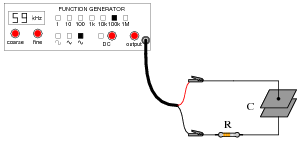
Explain why this happens, with reference to capacitive reactance (XC).
Reveal answerThe current will increase.
Follow-up question: combine the physical capacitance equation and the capacitive reactance equation together to form a new equation that solves for reactance (XC) given all the physical specifications of the capacitor (plate area, spacing, and permittivity) and the applied frequency:
C = εA dXC = 1 2 πf CNotes:Students might be able to guess the correct answer even if they know nothing about capacitive reactance, just by assuming that closer plates means a more complete circuit. The real answer is more complex than this, though, and that is what you must draw out of the discussion with them.