
 Facebook
 Google
 GitHub
 Linkedin
Discrete Semiconductor Devices and Circuits
Multi-Stage Transistor Amplifiers
15 questions By Tony R. Kuphaldt
-
Question 7 of 15
One of the problems with capacitively-coupled amplifier circuits is poor low-frequency response: as the input signal frequency decreases, all capacitive reactances increase, leading to a decreased voltage gain. One solution to this problem is the addition of a capacitor in the collector current path of the initial transistor stage:
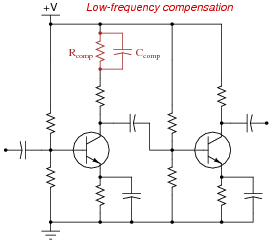
Explain how the presence of this “compensating” capacitor helps to overcome the loss of gain normally experienced as a result of the other capacitors in the circuit.
Reveal answerThe additional capacitor’s rising reactance at low frequencies boosts the gain of the first transistor stage by increasing the impedance from the first transistor’s collector to the V power supply rail.
Notes:This technique is commonly used in video amplifier circuits, although a complete video amplifier circuit would not be this crude (no peaking coils).
-
Question 8 of 15
This two-stage transistor amplifier circuit is transformer-coupled:
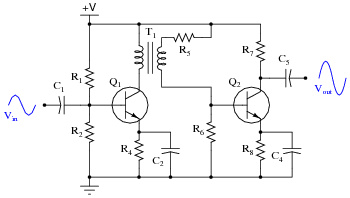
What advantage(s) does a transformer-coupled amplifier have over circuits using other methods of coupling? Are there any disadvantages to using a transformer for signal coupling between transistor stages? Explain in detail.
Reveal answerTransformers allow for impedance transformation between stages, as well as phase inversion (if desired). However, their parasitic (leakage) inductance and inter-winding capacitance may cause the amplifier to have strange frequency response characteristics.
Follow-up question: label the transformer’s polarity using “dot” notation in order to achieve no inversion of signal from input to output (as shown).
Notes:Ask your students to explain what impedance transformation is and why it is important, especially in amplifier circuits. This will be a good review of both transformer theory and the maximum power transfer theorem.
Regarding phase inversion, a fun challenge here is to have students specify the “dot convention” necessary for this particular transformer to obtain the non-inverting characteristic of this two-stage amplifier circuit. In other words, have them draw dots near the transformer windings (with the proper relative relationship) to produce the phasing shown by the sine-wave symbols in the diagram.
-
Question 9 of 15
Suppose two engineers were debating where to place a potentiometer in this audio amplifier circuit, to be used as a volume control:
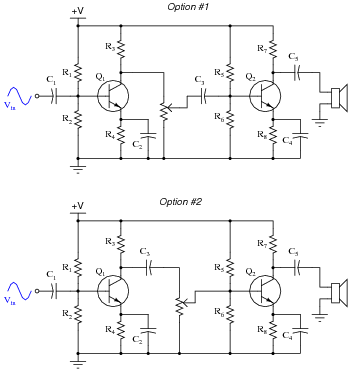
Which option would be better, and why? What ill effects could result from locating the potentiometer in the wrong place in this circuit?
Reveal answerOption #1 is definitely the better choice, because the potentiometer’s setting will not affect the biasing of Q2 as it would in option #2.
Notes:The purpose of this question is to make students realize that the biasing of each transistor stage is important in a multi-stage amplifier. One of the major challenges of designing a multi-stage amplifier is to ensure adequate signal coupling between stages without creating bias problems.




Just Awesome💔💔💔💔
Who wrote this article / worksheet? I really enjoyed it and would like to see more of their stuff