
 Facebook
 Google
 GitHub
 Linkedin
DC Electric Circuits
Series-Parallel DC Circuits
41 questions By Tony R. Kuphaldt
-
Question 31 of 41
What will happen to each resistor’s voltage and current in this circuit if resistor R1 fails open? Provide individual answers for each resistor, please.
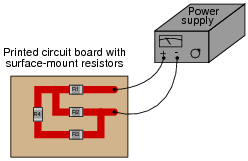
Reveal answerIf resistor R1 fails open . . .
- • VR1 will increase to full supply voltage, IR1 will decrease to zero
- • VR2 will decrease to zero, IR2 will decrease to zero
- • VR3 will decrease to zero, IR3 will decrease to zero
- • VR4 will decrease to zero, IR4 will decrease to zero
Follow-up question: note the order in which I list the qualitative effects of R2’s shorted failure. Reading from the top of the list to the bottom reveals the sequence of my reasoning. Explain why I would come to the conclusions I did, in the order I did.
Notes:I have found in teaching that many students loathe qualitative analysis, because they cannot let their calculators do the thinking for them. However, being able to judge whether a circuit parameter will increase, decrease, or remain the same after a component fault is an essential skill for proficient troubleshooting.
-
Question 32 of 41
What will happen to each resistor’s voltage and current in this circuit if resistor R2 fails shorted? Provide individual answers for each resistor, please.
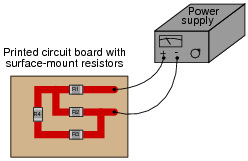
Reveal answerIf resistor R2 fails shorted . . .
- • VR2 will decrease to zero, IR2 will increase
- • VR1 will increase to full supply voltage, IR1 will increase
- • VR3 will decrease to zero, IR3 will decrease to zero
- • VR4 will decrease to zero, IR4 will decrease to zero
Follow-up question: note the order in which I list the qualitative effects of R2’s shorted failure. Reading from the top of the list to the bottom reveals the sequence of my reasoning. Explain why I would come to the conclusions I did, in the order I did.
Notes:I have found in teaching that many students loathe qualitative analysis, because they cannot let their calculators do the thinking for them. However, being able to judge whether a circuit parameter will increase, decrease, or remain the same after a component fault is an essential skill for proficient troubleshooting.
-
Question 33 of 41
What will happen to each resistor’s voltage in this circuit if resistor R4 fails shorted? Provide individual answers for each resistor, please.
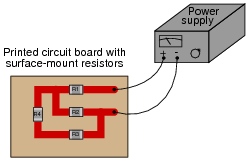
Also, comment on the practical likelihood of a resistor failing shorted, as opposed to failing open.
Reveal answerIf resistor R4 fails shorted . . .
- • VR4 will decrease to zero
- • VR1 will increase
- • VR2 will decrease
- • VR3 will increase
Follow-up question: resistors are actually far less likely to fail shorted as they are to fail open. However, this does not mean something else on a circuit board cannot go wrong to make it appear as though a resistor failed shorted! One example of such a fault is called a solder bridge. Explain what this is, any why it could produce the same effect as a resistor failing shorted.
Notes:I have found in teaching that many students loathe qualitative analysis, because they cannot let their calculators do the thinking for them. However, being able to judge whether a circuit parameter will increase, decrease, or remain the same after a component fault is an essential skill for proficient troubleshooting.


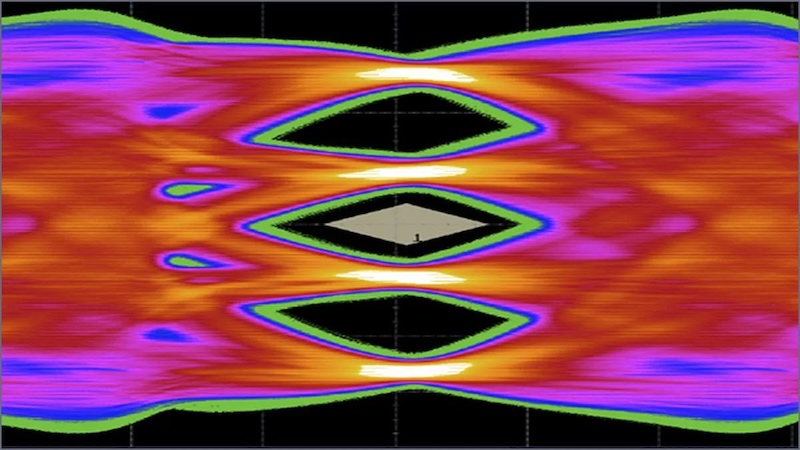



How did you guys find the answer for Q5, figure 6