
 Facebook
 Google
 GitHub
 Linkedin
DC Electric Circuits
Series-Parallel DC Circuits
41 questions By Tony R. Kuphaldt
-
Question 10 of 41
Identify which of these components are connected directly in series with each other, and which are connected directly in parallel with each other:

Assume that the open wire ends are connection points to a power source.
Reveal answerFigure 1:
R2 in parallel with R3.
Figure 2:
R1 in series with R2.
Figure 3:
R2 in series with R3.
Figure 4:
R1 in series with R2; R3 in series with R4.
Figure 5:
R1 in parallel with R3; R2 in parallel with R4.
Figure 6:
R1 in series with R2.
Notes:Work with your students to clearly identify rules by which series and parallel connections may be identified. This is extremely important for students to grasp if they are to be successful analyzing series-parallel networks of any kind. The most common problems I encounter as an electronics instructor with reference to series-parallel are invariably related to students’ lack of ability to consistently distinguish series sub-networks and parallel sub-networks in series-parallel combination circuits.
-
Question 11 of 41
Identify which of these components are connected directly in series with each other, and which are connected directly in parallel with each other:

Assume that the open wire ends are connection points to a power source. In circuits where ground symbols appear, consider ground as the other side of the power source.
Reveal answerFigure 1:
R1 in series with SW1.
Figure 2:
R1 in series with R2; R3 in parallel with R4.
Figure 3:
R1 parallel with R2.
Figure 4:
R1 parallel with R2.
Figure 5:
L1 in series with C1.
Figure 6:
R3 in parallel with R4.
Challenge question: if you compare figures 2 and 6, you see how merely changing the location(s) where the power supply connects to the network can alter the series/parallel relationships of the components. But, exactly what is it that is altered? If two components are in series with each other in one power source configuration, can that series relationship change by moving the power supply connection points? How about parallel connections? If two components are in parallel with each other, can that parallel relationship become altered merely by moving the points where the power source connects to the network? Explain.
Notes:Work with your students to clearly identify rules by which series and parallel connections may be identified. This is extremely important for students to grasp if they are to be successful analyzing series-parallel networks of any kind. The most common problems I encounter as an electronics instructor with reference to series-parallel are invariably related to students’ lack of ability to consistently distinguish series sub-networks and parallel sub-networks in series-parallel combination circuits.
-
Question 12 of 41
Identify which of these components are connected directly in series with each other, and which are connected directly in parallel with each other:
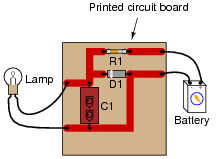
Reveal answerConnected directly in series: Battery and R1.

Connected directly in parallel: Lamp, C1, and D1

Notes:Students must have a firm understanding of what constitutes “series” versus “parallel” in real circuits. Here is a place where some students will feel uncomfortable because the textbook definitions they memorized are easier said than applied. It is imperative that students have a strong working knowledge of terms, and do not simply memorize definitions.








How did you guys find the answer for Q5, figure 6