
 Facebook
 Google
 GitHub
 Linkedin
DC Electric Circuits
Series-Parallel DC Circuits
41 questions By Tony R. Kuphaldt
-
Question 37 of 41
Examine these two variable-resistance (rheostat) networks, each one with a large-range potentiometer and a small-range potentiometer:

For each network, determine which pot is the coarse adjustment and which pot is the fine adjustment for total resistance.
Reveal answerSeries network
100k = Coarse adjustment ; 5k = Fine adjustment
Parallel network
5k = Coarse adjustment ; 100k = Fine adjustment
Notes:The purpose of this question is for students to identify the dominant resistance values in series versus parallel circuits. Remind your students if necessary that Rtotal > Rn for series and Rtotal < Rn for parallel (where Rn represents any particular resistor in the network).
-
Question 38 of 41
Identify which of these components are connected directly in series with each other, and which are connected directly in parallel with each other:
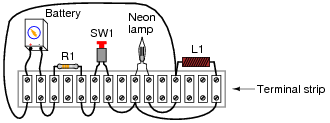
Reveal answerConnected directly in series: Battery, R1, and SW1. Connected directly in parallel: Neon lamp and L1.
Notes:Students must have a firm understanding of what constitutes “series” versus “parallel” in real circuits. Here is a place where some students will feel uncomfortable because the textbook definitions they memorized are easier said than applied. It is imperative that students have a strong working knowledge of terms, and do not simply memorize definitions.
-
Question 39 of 41
Complete the table of values for this circuit:

Reveal answer
Notes:Discuss with your students what a good procedure might be for calculating the unknown values in this problem, and also how they might check their work.
Students often have difficulty formulating a method of solution: determining what steps to take to get from the given conditions to a final answer. While it is helpful at first for you (the instructor) to show them, it is bad for you to show them too often, lest they stop thinking for themselves and merely follow your lead. A teaching technique I have found very helpful is to have students come up to the board (alone or in teams) in front of class to write their problem-solving strategies for all the others to see. They don’t have to actually do the math, but rather outline the steps they would take, in the order they would take them.
By having students outline their problem-solving strategies, everyone gets an opportunity to see multiple methods of solution, and you (the instructor) get to see how (and if!) your students are thinking. An especially good point to emphasize in these “open thinking” activities is how to check your work to see if any mistakes were made.






How did you guys find the answer for Q5, figure 6