
 Facebook
 Google
 GitHub
 Linkedin
DC Electric Circuits
Series-Parallel DC Circuits
41 questions By Tony R. Kuphaldt
-
Question 13 of 41
Rank these three light bulb assemblies according to their total electrical resistance (in order of least to greatest), assuming that each of the bulbs is the same type and rating:

Explain how you determined the relative resistances of these light bulb networks.
Reveal answer- • C (least total resistance)
- • A
- • B (greatest total resistance)
Notes:I prefer to enter discussion on series and parallel circuits prior to introducing Ohm’s Law. Conceptual analysis tends to be more difficult than numerical analysis in electric circuits, but is a skill worthwhile to build, especially for the sake of effective troubleshooting.
It is effective after conceptual (qualitative) analysis, though, to go through a numerical (quantitative) analysis of a circuit like this to prove that the concepts are correct, if the students are advanced enough at this point to do series-parallel resistance calculations.
-
Question 14 of 41
Which components are guaranteed to share the exact same voltage by virtue of their connections with each other? Which components are guaranteed to share the exact same current by virtue of their connections with each other?
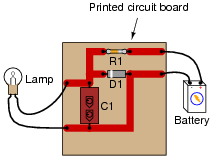
Reveal answerThe lamp, C1, and D1 are all guaranteed to share the exact same voltage. The battery and R1 are both guaranteed to share the exact same current.
Notes:Here, the important relations between voltage, current, and component connection patterns are explored. This serves to further define, in practical ways, what the terms “series” and “parallel” really mean.
-
Question 15 of 41
Which components in this partial automobile schematic diagram are guaranteed to share the exact same voltage by virtue of their connections with each other? Which components are guaranteed to share the exact same current by virtue of their connections with each other?

Reveal answerThe two headlights are guaranteed to share the same voltage. So are the two brake lights. However, the voltage across the brake lights may not be the same as the voltage across the headlights at any given time!
So long as the fusible link is not “blown,” the generator and battery will share approximately the same voltage.
The ammeter, fusible link, and generator are all guaranteed to share the same current.
Notes:Here, the important relations between voltage, current, and component connection patterns are explored. This serves to further define, in practical ways, what the terms “series” and “parallel” really mean.
This question also affords the opportunity of discussing what a “fusible link” is, and how it compares to fuses and circuit breakers as an overcurrent protection device.





How did you guys find the answer for Q5, figure 6