Facebook
 Google
 GitHub
 Linkedin
Digital Circuits
Flip-Flop Circuits
26 questions By Tony R. Kuphaldt
-
Question 16 of 26
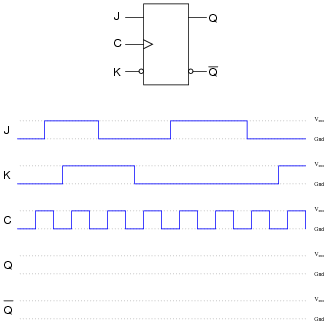
Determine the output states for this J-K flip-flop, given the pulse inputs shown:
Reveal answer
Notes:Ask students to identify those regions on the timing diagram where the flip-flop is being set, reset, and toggled.
-
Question 17 of 26
Flip-flops often come equipped with asynchronous input lines as well as synchronous input lines. This J-K flip-flop, for example, has both “preset” and “clear” asynchronous inputs:

Describe the functions of these inputs. Why would we ever want to use them in a circuit? Explain what the “synchronous” inputs are, and why they are designated by that term.
Also, note that both of the asynchronous inputs are active-low. As a rule, asynchronous inputs are almost always active-low rather than active-high, even if all the other inputs on the flip-flop are active-high. Why do you suppose this is?
Reveal answer“Asynchronous” inputs force the outputs to either the “set” or “reset” state independent of the clock. “Synchronous” inputs have control over the flip-flop’s outputs only when the clock pulse allows.
As for why the asynchronous inputs are active-low, I won’t directly give you the answer. But I will give you a hint: consider a TTL implementation of this flip-flop.
Notes:Note to your students that sometimes the Preset and Clear inputs are called direct set and direct reset, respectively. Review with your students what it means for an input to be “active-low” versus “active-high.” Ask them what consequences might arise if a circuit designer misunderstood the input states and failed to provide the right type of signal to the circuit.
-
Question 18 of 26
A scientist is using a microprocessor system to monitor the boolean (“high” or “low”) status of a particle sensor in her high-speed nuclear experiment. The problem is, the nuclear events detected by the sensor come and go much faster than the microprocessor is able to sample them. Simply put, the pulses output by the sensor are too brief to be “caught” by the microprocessor every time:
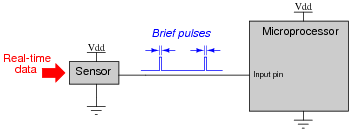
She asks several technicians to try and fix the problem. One tries altering the microprocessor’s program to achieve a faster sampling rater, to no avail. Another recalibrates the particle sensor to react slower, but this only results in missed data (because the real world data does not slow down accordingly!). No solution tried so far works, because the fundamental problem is that the microprocessor is just too slow to “catch” the extremely short pulse events coming from the particle sensor. What is required is some kind of external circuit to “read” the sensor’s state at the leading edge of a sample pulse, and then hold that digital state long enough for the microprocessor to reliably register it.
Finally, another electronics technician comes along and proposes this solution, but then goes on vacation, leaving you to implement it:
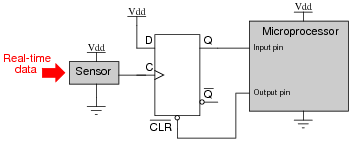
Explain how this D-type flip-flop works to solve the problem, and what action the microprocessor has to take on the output pin to make the flip-flop function as a detector for multiple pulses.
Reveal answerThe flip-flop becomes “set” every time a pulse comes from the sensor. The microprocessor must clear the flip-flop after reading the captured pulse, so the flip-flop will be ready to capture and hold a new pulse.
Challenge question: what logic family of flip-flop would you recommend be used for this application, given the need for extremely fast response? Don’t just say “TTL,” either. Research the fastest modern logic family in current manufacture!
Notes:This is a very practical application for a D-type flip-flop, and also an introduction to one of the pitfalls of microprocessor-based data acquisition systems. Explain to your students that the finite time required for a microprocessor to cycle through its program may lead to conditions such as this where real-time events are missed because the microprocessor was “busy” doing other things at the time.