Facebook
 Google
 GitHub
 Linkedin
Digital Circuits
Flip-Flop Circuits
26 questions By Tony R. Kuphaldt
-
Question 25 of 26
A student has an idea to make a J-K flip-flop toggle: why not just connect the J, K, and Clock inputs together and drive them all with the same square-wave pulse? If the inputs are active-high and the clock is positive edge-triggered, the J and K inputs should both go “high” at the same moment the clock signal transitions from low to high, thus establishing the necessary conditions for a toggle (J=1, K=1, clock transition):

Unfortunately, the J-K flip-flop refuses to toggle when this circuit is built. No matter how many clock pulses it receives, the Q and [Q] outputs remain in their original states - the flip-flop remains “latched.” Explain the practical reason why the student’s flip-flop circuit idea will not work.
Reveal answerWith all inputs tied together, there is zero setup time on the J and K inputs before the clock pulse rises.
Notes:The purpose of this question is to get students to think about setup time, and to see its importance by providing a scenario where the circuit will not work because this parameter has been ignored.
-
Question 26 of 26
Predict how the operation of this sound-activated lamp circuit will be affected as a result of the following faults. Consider each fault independently (i.e. one at a time, no multiple faults):
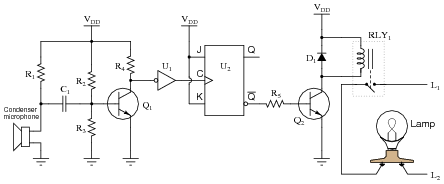
- Resistor R1 fails open:
- Resistor R3 fails open:
- Diode D1 fails open:
- Transistor Q2 fails shorted between collector and emitter:
- Solder bridge past resistor R5:
For each of these conditions, explain why the resulting effects will occur.
Reveal answer- Resistor R1 fails open: Lamp status does not change.
- Resistor R3 fails open: Lamp status does not change.
- Diode D1 fails open: Circuit works fine for a few cycles, then fails with the lamp either remaining on or remaining off (due to failed transistor Q2).
- Transistor Q2 fails shorted between collector and emitter: Lamp remains on.
- Solder bridge past resistor R5: Possible failure of flip-flop U2 or transistor Q2 after extended periods of time with the lamp on.
Notes:The purpose of this question is to approach the domain of circuit troubleshooting from a perspective of knowing what the fault is, rather than only knowing what the symptoms are. Although this is not necessarily a realistic perspective, it helps students build the foundational knowledge necessary to diagnose a faulted circuit from empirical data. Questions such as this should be followed (eventually) by other questions asking students to identify likely faults based on measurements.