Facebook
 Google
 GitHub
 Linkedin
Discrete Semiconductor Devices and Circuits
Bipolar Junction Transistors as Switches
34 questions By Tony R. Kuphaldt
-
Question 22 of 34
Write the mathematical formula defining β for a bipolar junction transistor:
$$\beta =$$
Reveal answer$$\beta = \frac{I_C}{I_B}$$
Notes:This definition may be found in any introductory electronics textbook, so you should ask you students to explain something about this formula in order to make it a meaningful discussion question. Suitable explanations to request would be:
- What are some typical values for β?
- Is β always greater than 1 or less than 1? What does this suggest about the two transistor currents in the formula?
- What would the β value be for an ideal transistor?
-
Question 23 of 34
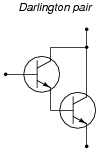
An easy way to increase the effective current gain of a transistor is to “cascade” two of them in a configuration called a Darlington pair:
Complete this schematic diagram, showing how a Darlington pair could be used to enable a cadmium sulfide (CdS) photocell to turn a motor on and off:

Reveal answer
Notes:Ask your students to define “gain” as it applies to a transistor circuit. Ask them to explain why a Darlington pair has a greater current gain than a single transistor, and why that trait is important in a circuit such as this.
-
Question 24 of 34
Calculate all labeled currents in this Darlington pair circuit (shown in this schematic in conventional flow notation), assuming a typical forward base-emitter junction voltage drop of 0.7 volts for each transistor:
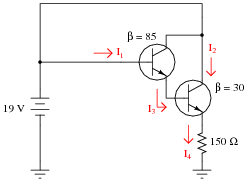
Reveal answer- I1 = 44.01 μA
- I2 = 113.5 mA
- I3 = 3.785 mA
- I4 = 117.3 mA
Notes:Have your students come to the front of the class, either as individuals or as groups, and present problem-solving techniques for determining the unknown currents.