Facebook
 Google
 GitHub
 Linkedin
Discrete Semiconductor Devices and Circuits
Junction field-effect transistors (JFET)
43 questions By Tony R. Kuphaldt
-
Question 10 of 43
From the “diode check” measurements taken with these two meters, identify the terminals on this JFET, and also what type of JFET it is (N-channel or P-channel):
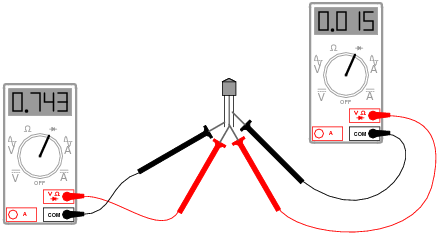
Reveal answerThe left-most terminal on this JFET is the gate, and the other two are source and drain. This is a P-channel JFET.
Notes:Ask your students to explain why the gate-channel junction registers a voltage drop of 0.743 volts, while the source-drain path only registers 15 millivolts of drop. What does this indicate about the conductivity of JFET compared to that of a BJT? Also, what does this suggest about the minimum source-drain voltage necessary for controlled current to go through the JFET?
-
Question 11 of 43
Identify which transistor terminal functions as the source and which transistor terminal functions as the drain in both of these JFET circuits:

Most importantly, explain why we define the terminals as such, given the fact that is usually no physical difference between these two terminals of a JFET.
Reveal answer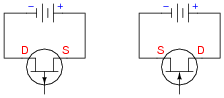
The “why” answer is related to the type of majority charge carrier within the channel of each JFET.
Notes:The distinction between source and drain for any kind of FET (JFET or MOSFET) is important because the controlling voltage (VGS) must be applied between gate and source, not between gate and drain.
-
Question 12 of 43
Junction field-effect transistors (JFETs) are normally-on devices, the natural state of their channels being passable to electric currents. Thus, a state of cutoff will only occur on command from an external source.
Explain what must be done to a JFET, specifically, to drive it into a state of cutoff.
Reveal answerThe gate-channel PN junction must be reverse-biased: a voltage applied between gate and source such that the negative side is connected to the “P” material and the positive side to the “N” material.
Follow-up question: is any gate current required to drive a JFET into the cutoff state? Why or why not?
Notes:This is perhaps the most important question your students could learn to answer when first studying JFETs. What, exactly, is necessary to turn one off? Have your students draw diagrams to illustrate their answers as they present in front of the class.