Facebook
 Google
 GitHub
 Linkedin
Discrete Semiconductor Devices and Circuits
Junction field-effect transistors (JFET)
43 questions By Tony R. Kuphaldt
-
Question 22 of 43
Draw the connecting wires to form a circuit where the transistor turns the LED off whenever the pushbutton switch is actuated:

Reveal answer
Notes:Ask your students to describe the biasing of the gate-channel junction inside the transistor when the switch is closed. Is this PN junction forward-biased, or reverse-biased? What does this biasing do inside the transistor to interrupt current to the LED?
Note that there is no resistor shown in this circuit, because many small-signal JFETs have values of IDSS within the operating range of common LEDs. In other words, the JFET itself acts as a current-limiting device to protect the LED.
-
Question 23 of 43
Junction field-effect transistors are very sensitive devices, requiring practically zero current to “drive” them into either cutoff or saturation. However, they usually cannot handle high drain currents - in other words, they are not considered “power” switching devices.
If we combine a JFET with a BJT, though, we may realize the best features of each transistor: low drive current requirements combined with a high controlled current rating. Examine the following hybrid JFET/BJT circuits, and explain how each one works to control power to the load:
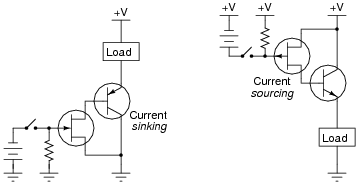
Determine for each circuit whether the load becomes energized when the switch is closed or when it is opened, and explain how each one works.
Reveal answerIn each case, the load de-energizes with switch closure, and energizes when the switch is opened.
Follow-up question: explain the purpose of the resistor in each circuit. What might happen if it were not there?
Notes:This question is a good review of both BJT and JFET operating theory, as well as a practical example of how “cascading” different types of transistors may result in “best of both worlds” performance.
-
Question 24 of 43
Junction field-effect transistors have the ability to perform some functions that are impossible with (single) bipolar junction transistors. Take this circuit, for example:
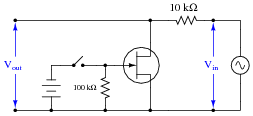
What effect will opening and closing the toggle switch have on the AC signal measured at the output terminals?
Reveal answerWhen the toggle switch is open, the output signal will fall to (nearly) 0 volts AC. When the toggle switch is closed, the output signal will be (nearly) the same as Vin.
Notes:Discuss how the JFET is able to perform this AC signal “shunting” function, whereas a BJT would not be able to do the same. Can your students think of any practical applications of a circuit like this?