Facebook
 Google
 GitHub
 Linkedin
Discrete Semiconductor Devices and Circuits
Junction field-effect transistors (JFET)
43 questions By Tony R. Kuphaldt
-
Question 25 of 43
Predict how this circuit will be affected as a result of the following faults. Consider each fault independently (i.e. one at a time, no multiple faults):
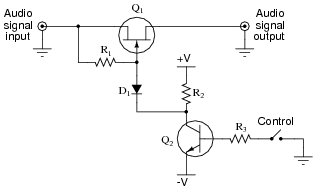
- Diode D1 fails open:
- Transistor Q1 fails shorted (drain-to-source):
- Transistor Q1 fails open (drain-to-source):
- Transistor Q2 fails shorted (collector-to-emitter):
For each of these conditions, explain why the resulting effects will occur.
Reveal answer- Diode D1 fails open: Audio signal always passes through and cannot be turned off.
- Transistor Q1 fails shorted (drain-to-source): Audio signal always passes through and cannot be turned off.
- Transistor Q1 fails open (drain-to-source): Audio signal never passes through and cannot be turned on.
- Transistor Q2 fails shorted (collector-to-emitter): Audio signal never passes through and cannot be turned on.
Notes:The purpose of this question is to approach the domain of circuit troubleshooting from a perspective of knowing what the fault is, rather than only knowing what the symptoms are. Although this is not necessarily a realistic perspective, it helps students build the foundational knowledge necessary to diagnose a faulted circuit from empirical data. Questions such as this should be followed (eventually) by other questions asking students to identify likely faults based on measurements.
-
Question 26 of 43
Junction Field-Effect Transistors (JFETs) differ in behavior from Bipolar Junction Transistors (BJTs) in several ways. Address each one of these behavioral aspects in your answer:
- Current gain
- Conduction with no input (gate/base) signal
- Polarization
Reveal answerJFETs have much greater current gains than BJTs.
JFETs are normally-on devices. BJTs are normally-off devices.
JFETs can pass current from source to drain, or from drain to source with equal ease. BJTs can only pass current from emitter to collector in one direction.
Notes:For each one of these behavioral aspects, discuss with your students exactly why the two transistors types differ.
-
Question 27 of 43
When measuring the resistance of a JFET from source to drain, the ohmmeter reading may be seen to change simply by touching the gate terminal with your finger:
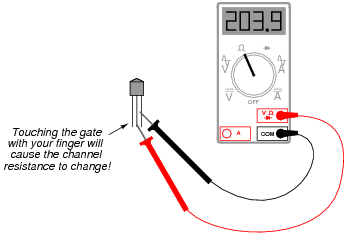
Such a degree of sensitivity is unheard of in bipolar junction transistors. Explain why the JFET is so sensitive, and comment on what advantages and disadvantages this gives the JFET as an electronic device.
Reveal answerThe gate-channel PN junction of a JFET normally operates in reverse-bias mode, whereas bipolar transistors require a forward current for emitter-collector conduction.
Notes:The stated answer is purposefully vague, to force students to think and to express the answer in their own words.
It is quite easy to demonstrate this sensitivity in the classroom with nothing more than an ohmmeter and a JFET, and so I encourage you to set this up as a demonstration for your students.