Facebook
 Google
 GitHub
 Linkedin
Discrete Semiconductor Devices and Circuits
Junction field-effect transistors (JFET)
43 questions By Tony R. Kuphaldt
-
Question 19 of 43
Determine what status the LED will be in (either “on” or “off”) for both switch positions in this JFET switching circuit:
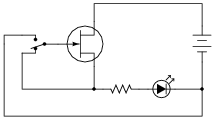
Reveal answerThe switch is shown in the “LED on” position.
Notes:Ask your students to explain their reasoning for their switch position determinations.
-
Question 20 of 43
This circuit has an unusual problem. When the switch is open, the LED turns on. When the switch is closed, the LED turns off. However, when the switch is opened again, the LED often does not turn back on until some time has passed. Others notice that sometimes the LED will turn on and off just by waving their hand next to it, with the switch in the open position.

Explain what is happening here, and also propose a solution to eliminate the unpredictability when the switch is open.
Reveal answerThe LED status is unpredictable when the switch is open, because the transistor’s gate is free to “pick up” static electric voltages induced by nearby objects. The solution is to provide a resistive path for any static voltage to discharge when the switch is open.
Notes:Challenge your students to place a resistor in this circuit in such a way as to meet the requirements of the given solution.
Incidentally, this circuit makes an excellent classroom demonstration for students to experiment with.
-
Question 21 of 43
What is wrong with this JFET circuit? What might happen to the transistor if this circuit is built and operated?

Reveal answerThe gate-channel PN junction inside a JFET is not designed to handle much forward current!
Notes:Have your students consult a typical JFET datasheet and research the maximum gate current parameter. Discuss this parameter with your students, and also talk about how we can make sure this limitation is not exceeded in any circuit design.
The latter subject is very important for students because I have seen many a JFET destroyed by this exact type of abuse.