Facebook
 Google
 GitHub
 Linkedin
AC Electric Circuits
Passive Integrator and Differentiator Circuits
25 questions By Tony R. Kuphaldt
-
Question 16 of 25
Complete the following sentences with one of these phrases: “shorter than,” “longer than,” or “equal to”. Then, explain why the time constant of each circuit type must be so.
- Passive integrator circuits should have time constants that are (fill-in-the-blank) the period of the waveform being integrated.
- Passive differentiator circuits should have time constants that are (fill-in-the-blank) the period of the waveform being differentiated.
Reveal answerPassive integrators need to have slow time constants, while passive differentiators need to have fast time constants, in order to reasonably integrate and differentiate.
Notes:If students don’t understand why this is, let them work through an example problem, to see what the output waveform(s) would look like for various periods and time constants. Remember to stress what an ideal integrator or differentiator is supposed to do!
-
Question 17 of 25
∫f(x) dx Calculus alert!
Both the input and the output of this circuit are square waves, although the output waveform is slightly distorted and also has much less amplitude:
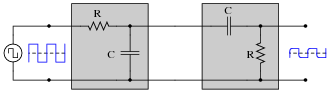
You recognize one of the RC networks as a passive integrator, and the other as a passive differentiator. What does the likeness of the output waveform compared to the input waveform indicate to you about differentiation and integration as functions applied to waveforms?
Reveal answerDifferentiation and integration are mathematically inverse functions of one another. With regard to waveshape, either function is reversible by subsequently applying the other function.
Follow-up question: this circuit will not work as shown if both R values are the same, and both C values are the same as well. Explain why, and also describe what value(s) would have to be different to allow the original square-waveshape to be recovered at the final output terminals.
Notes:That integration and differentiation are inverse functions will probably be obvious already to your more mathematically inclined students. To others, it may be a revelation.
If time permits, you might want to elaborate on the limits of this complementarity. As anyone with calculus background knows, integration introduces an arbitrary constant of integration. So, if the integrator stage follows the differentiator stage, there may be a DC bias added to the output that is not present in the input (or visa-versa!).
⌠ ⌡ d dx[ f(x) ] dx = f(x) + C In a circuit such as this where integration precedes differentiation, ideally there is no DC bias (constant) loss:
d dx[ ⌠ ⌡ f(x) dx ] = f(x) However, since these are actually first-order “lag” and “lead” networks rather than true integration and differentiation stages, respectively, a DC bias applied to the input will not be faithfully reproduced on the output. Whereas a true integrator would take a DC bias input and produce an output with a linearly ramping bias, a passive integrator will assume an output bias equal to the input bias.
Incidentally, the following values work well for a demonstration circuit:Therefore, the subsequent differentiation stage, perfect or not, has no slope to differentiate, and thus there will be no DC bias on the output.

Footnotes:
If this is not apparent to you, I suggest performing Superposition analysis on a passive integrator (consider AC, then consider DC separately), and verify that VDC(out) = VDC(in). A passive differentiator circuit would have to possess an infinite time constant (τ = ∞) in order to generate this ramping output bias! -
Question 18 of 25
∫f(x) dx Calculus alert!
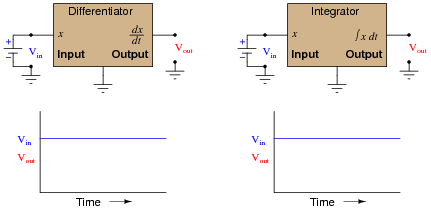
Determine what the response will be to a constant DC voltage applied at the input of these (ideal) circuits:
Reveal answer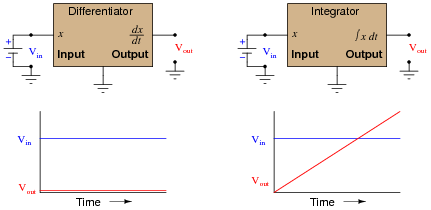
Notes:Ask your students to frame their answers in a practical context, such as speed and distance for a moving object (where speed is the time-derivative of distance and distance is the time-integral of speed).