Facebook
 Google
 GitHub
 Linkedin
AC Electric Circuits
Passive Integrator and Differentiator Circuits
25 questions By Tony R. Kuphaldt
-
Question 7 of 25
Plot the output waveform of a passive differentiator circuit, assuming the input is a symmetrical square wave and the circuit’s RC time constant is about one-fifth of the square wave’s pulse width:
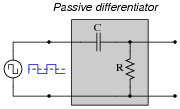
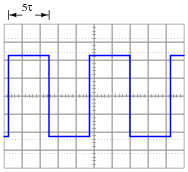
Reveal answer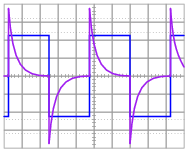
Follow-up question #1: what would we have to change in this passive differentiator circuit to make the output more closely resemble ideal differentiation?
Follow-up question #2: explain how it is possible that the differentiator’s output waveform has a greater peak amplitude than the input (square) waveform.
Notes:Ask students to contrast the behavior of this passive differentiator circuit against that of a perfect differentiator (with τ = 0). What should the derivative plot of a square wave look like?
-
Question 8 of 25
∫f(x) dx Calculus alert!
Potentiometers are very useful devices in the field of robotics, because they allow us to represent the position of a machine part in terms of a voltage. In this particular case, a potentiometer mechanically linked to the joint of a robotic arm represents that arm’s angular position by outputting a corresponding voltage signal:
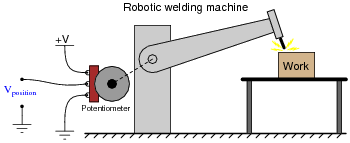
As the robotic arm rotates up and down, the potentiometer wire moves along the resistive strip inside, producing a voltage directly proportional to the arm’s position. A voltmeter connected between the potentiometer wiper and ground will then indicate arm position. A computer with an analog input port connected to the same points will be able to measure, record, and (if also connected to the arm’s motor drive circuits) control the arm’s position.
If we connect the potentiometer’s output to a differentiator circuit, we will obtain another signal representing something else about the robotic arm’s action. What physical variable does the differentiator output signal represent?
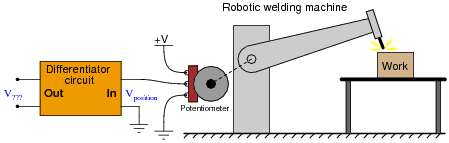
Reveal answerThe differentiator circuit’s output signal represents the angular velocity of the robotic arm, according to the following equation:
v = dx dtWhere,
v = velocity
x = position
t = time
Follow-up question: what type of signal will we obtain if we differentiate the position signal twice (i.e. connect the output of the first differentiator circuit to the input of a second differentiator circuit)?
Notes:This question asks students to relate the concept of time-differentiation to physical motion, as well as giving them a very practical example of how a passive differentiator circuit could be used. In reality, one must be very careful to use differentiator circuits for real-world signals because differentiators tend to amplify high-frequency noise. Since real-world signals are often “noisy,” this leads to a lot of noise in the differentiated signals.
-
Question 9 of 25
∫f(x) dx Calculus alert!
One of the fundamental principles of calculus is a process called integration. This principle is important to understand because it is manifested in the behavior of capacitance. Thankfully, there are more familiar physical systems which also manifest the process of integration, making it easier to comprehend.If we introduce a constant flow of water into a cylindrical tank with water, the water level inside that tank will rise at a constant rate over time:
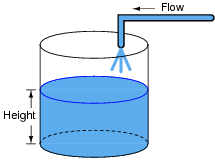
In calculus terms, we would say that the tank integrates water flow into water height. That is, one quantity (flow) dictates the rate-of-change over time of another quantity (height).
Like the water tank, electrical capacitance also exhibits the phenomenon of integration with respect to time. Which electrical quantity (voltage or current) dictates the rate-of-change over time of which other quantity (voltage or current) in a capacitance? Or, to re-phrase the question, which quantity (voltage or current), when maintained at a constant value, results in which other quantity (current or voltage) steadily ramping either up or down over time?
Reveal answerIn a capacitance, voltage is the time-integral of current. That is, the applied current “through” the capacitor dictates the rate-of-change of voltage across the capacitor over time.
Challenge question: can you think of a way we could exploit the similarity of capacitive voltage/current integration to simulate the behavior of a water tank’s filling, or any other physical process described by the same mathematical relationship?
Notes:The concept of integration doesn’t have to be overwhelmingly complex. Electrical phenomena such as capacitance and inductance may serve as excellent contexts in which students may explore and comprehend the abstract principles of calculus. The amount of time you choose to devote to a discussion of this question will depend on how mathematically adept your students are.
Hopefully, the challenge question will stir your students’ imaginations, as they realize the usefulness of electrical components as analogues for other types of physical systems.