Facebook
 Google
 GitHub
 Linkedin
AC Electric Circuits
Passive Integrator and Differentiator Circuits
25 questions By Tony R. Kuphaldt
-
Question 10 of 25
∫f(x) dx Calculus alert!
One of the fundamental principles of calculus is a process called integration. This principle is important to understand because it is manifested in the behavior of inductance. Thankfully, there are more familiar physical systems which also manifest the process of integration, making it easier to comprehend.If we introduce a constant flow of water into a cylindrical tank with water, the water level inside that tank will rise at a constant rate over time:
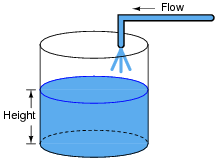
In calculus terms, we would say that the tank integrates water flow into water height. That is, one quantity (flow) dictates the rate-of-change over time of another quantity (height).
Like the water tank, electrical inductance also exhibits the phenomenon of integration with respect to time. Which electrical quantity (voltage or current) dictates the rate-of-change over time of which other quantity (voltage or current) in an inductance? Or, to re-phrase the question, which quantity (voltage or current), when maintained at a constant value, results in which other quantity (current or voltage) steadily ramping either up or down over time?
Reveal answerIn an inductance, current is the time-integral of voltage. That is, the applied voltage across the inductor dictates the rate-of-change of current through the inductor over time.
Challenge question: can you think of a way we could exploit the similarity of inductive voltage/current integration to simulate the behavior of a water tank’s filling, or any other physical process described by the same mathematical relationship?
Notes:The concept of integration doesn’t have to be overwhelmingly complex. Electrical phenomena such as capacitance and inductance may serve as excellent contexts in which students may explore and comprehend the abstract principles of calculus. The amount of time you choose to devote to a discussion of this question will depend on how mathematically adept your students are.
-
Question 11 of 25
Describe what happens to the capacitor voltage in this circuit over time as it is charged by the constant-current source:
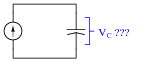
Now, determine the ideal values for V and R that will result in similar behavior in a capacitor circuit powered by a voltage source rather than a current source:

Your answers will, of course, be qualitative rather than quantitative. Explain whether or not the time constant for the voltage-source-powered circuit ought to be large or small, and why.
Reveal answerBoth V and R should be extremely large values in order to mimic the behavior of a current source.
Notes:In this question, I ask students to identify the behavior of a true integrator circuit, and then contrast it with the behavior of what is more accurately known as a first-order lag circuit (the RC circuit powered by the voltage source). Of course, the two circuits do not behave the same, but through judicious choices of V and C, one can make the “lag” circuit closely mimic the true integrator circuit over a practical range of capacitor voltage.
-
Question 12 of 25
It is relatively easy to design and build an electronic circuit to make square-wave voltage signals. More difficult to engineer is a circuit that directly generates triangle-wave signals. A common approach in electronic design when triangle waves are needed for an application is to connect a passive integrator circuit to the output of a square-wave oscillator, like this:
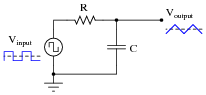
Anyone familiar with RC circuits will realize, however, that a passive integrator will not output a true triangle wave, but rather it will output a waveshape with “rounded” leading and trailing edges:
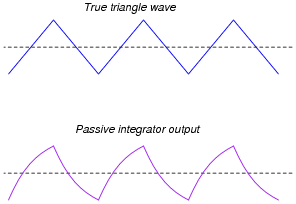
What can be done with the values of R and C to best approximate a true triangle wave? What variable must be compromised to achieve the most linear edges on the integrator output waveform? Explain why this is so.
Reveal answerMaximum values of R and C will best approximate a true triangle wave. The consequences of choosing extremely large values for R and/or C are not difficult to determine - I leave that for you to explain!
Notes:This question asks students to recognize conflicting design needs, and to balance one need against another. Very practical skills here, as real-life applications almost always demand some form of practical compromise in the design stage.
If students cannot figure out what must be sacrificed to achieve waveshape linearity, tell them to build such a circuit and see for themselves!