Facebook
 Google
 GitHub
 Linkedin
AC Electric Circuits
Passive Integrator and Differentiator Circuits
25 questions By Tony R. Kuphaldt
-
Question 22 of 25
Calculate the output voltage of this passive differentiator circuit 1 millisecond after the rising edge of each positive square wave pulse (where the square wave transitions from -5 volts to 5 volts):
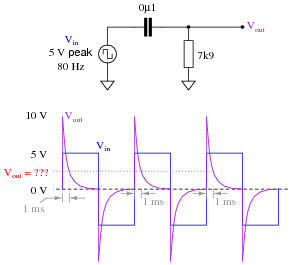
Reveal answerVout = 2.82 volts @ 1 ms after rising edge
Notes:This question is nothing more than an exercise in time-constant circuit calculations: determining how far the output voltage has decayed from its peak of 10 volts after 1 millisecond. Ask your students to share their techniques for problem-solving with the whole class.
-
Question 23 of 25
Calculate the output voltage of this passive differentiator circuit 150 microseconds after the rising edge of each “clock” pulse (where the square wave transitions from 0 volts to 5 volts):
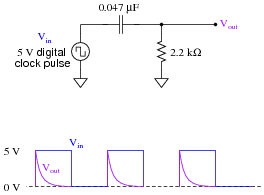
Reveal answerVout = 1.172 volts @ 150 μs after rising edge
Notes:This question is nothing more than an exercise in time-constant circuit calculations: determining how far the output voltage has decayed from its peak of 5 volts after 150 μs. Ask your students to share their techniques for problem-solving with the whole class.
-
Question 24 of 25
A passive differentiator is used to “shorten” the pulse width of a square wave by sending the differentiated signal to a “level detector” circuit, which outputs a “high” signal ( 5 volts) whenever the input exceeds 3.5 volts and a “low” signal (0 volts) whenever the input drops below 3.5 volts:
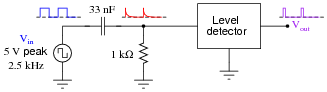
Each time the differentiator’s output voltage signal spikes up to 5 volts and quickly decays to 0 volts, it causes the level detector circuit to output a narrow voltage pulse, which is what we want.
Calculate how wide this final output pulse will be if the input (square wave) frequency is 2.5 kHz.
Reveal answertpulse = 11.77 μs
Notes:This question requires students to calculate a length of time in an RC circuit, given specific voltage levels and component values. It is a very practical question, as it may be necessary to build or troubleshoot such a circuit some day!