Facebook
 Google
 GitHub
 Linkedin
AC Electric Circuits
Passive Integrator and Differentiator Circuits
25 questions By Tony R. Kuphaldt
-
Question 25 of 25
A passive integrator circuit is energized by a square wave signal with a peak-to-peak amplitude of 12 volts and a frequency of 65.79 Hz:
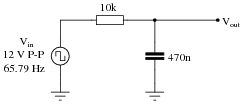
Determine the peak-to-peak voltage of the output waveform:
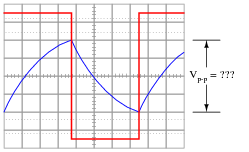
Hint: the output waveform will be centered exactly half-way between the two peaks of the input square wave as shown in the oscilloscope image. Do not base your answer on relative sizes of the two waveforms, as I have purposely skewed the calibration of the oscilloscope screen image so the two waveforms are not to scale with each other.
Reveal answerVout (peak-to-peak) = 8.025 volts
Follow-up question: the components comprising this circuit are improperly sized if it is actually expected to function as a reasonably accurate integrator. Suggest better component values for the frequency of signal being integrated.
Challenge question: write a formula that solves for this peak-to-peak output voltage (Vout) given the peak-to-peak input voltage (Vin), resistor value R, capacitor value C, and signal frequency f.
Notes:This is an interesting problem to set up. Ask your students what approach they used, so they all can see multiple problem-solving techniques. I based my own solution on the RC circuit decay equation e−t / τ with x volts being my starting condition and -6 volts being my final condition (if time t is infinite), then I just solved for x. With my method, x is the peak signal voltage, not the peak-to-peak, so I just doubled it to get the final answer.
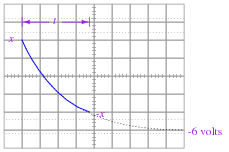
My own answer for the challenge question is this:
Vout = Vin(1 − e[(−1)/2RCf]) 1 + e[(−1)/2RCf]Your mileage may vary . . .