Facebook
 Google
 GitHub
 Linkedin
Discrete Semiconductor Devices and Circuits
Regulated Power Sources
28 questions By Tony R. Kuphaldt
-
Question 4 of 28
The purpose of a current mirror circuit is to maintain constant current through a load despite changes in that load’s resistance:
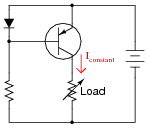
If we were to crudely model the transistor’s behavior as an automatically-varied rheostat - constantly adjusting resistance as necessary to keep load current constant - how would you describe this rheostat’s response to changes in load resistance?
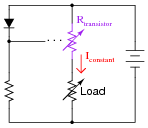
In other words, as Rload increases, what does Rtransistor do - increase resistance, decrease resistance, or remain the same resistance it was before? How does the changing value of Rtransistor affect total circuit resistance?
Reveal answerAs Rload increases, Rtransistor will decrease in resistance so as to maintain a constant current through the load and a constant Rtotal.
Notes:This model of current mirror transistor behavior, albeit crude, serves as a good introduction to the subject of active loads in transistor amplifier circuits. This is where a transistor is configured to operate as a constant-current regulator, then placed in series with an amplifying transistor to yield much greater voltage gains than what is possible with a passive (fixed resistor) load.
-
Question 5 of 28
Based on what you know about bipolar junction transistors, what will the collector current do (increase, decrease, or remain the same) if the variable voltage source increases in voltage? The small, fixed voltage source (0.7 volts) is just enough to make the transistor conduct, but not enough to fully saturate it.

From the variable voltage source’s perspective, what does the transistor circuit “look” like? It certainly does not look resistive, because a resistive circuit would increase current linearly with increases in applied voltage! If you could relate the behavior of this circuit to a common idealized electrical component, what would it be?
Reveal answerThe collector current will remain (approximately) the same as the variable voltage source increases in magnitude. In this manner, the transistor circuit “looks” like a current source.
Notes:This question is really nothing more than review of a transistor’s characteristic curves. You might want to ask your students to relate this circuit’s behavior to the common characteristic curves shown in textbooks for bipolar junction transistors. What portion of the characteristic curve is this transistor operating in while it regulates current?
-
Question 6 of 28
Based on what you know about bipolar junction transistors, what will the collector current do (increase, decrease, or remain the same) if the variable resistor’s resistance is decreased? The small voltage source (0.7 volts) is just enough to make the transistor conduct, but not enough to fully saturate it.

From the variable resistor’s perspective, what does the rest of the transistor circuit “look” like?
Reveal answerThe collector current will remain (approximately) the same as the variable resistance is changed. In this manner, the transistor circuit “looks” like a current source to the variable resistor.
Notes:This question is really nothing more than review of a transistor’s characteristic curves. You might want to ask your students to relate this circuit’s behavior to the common characteristic curves shown in textbooks for bipolar junction transistors. What portion of the characteristic curve is this transistor operating in while it regulates current?