Facebook
 Google
 GitHub
 Linkedin
Discrete Semiconductor Devices and Circuits
Regulated Power Sources
28 questions By Tony R. Kuphaldt
-
Question 25 of 28
Describe how a zener diode is able to maintain regulated (nearly constant) voltage across the load, despite changes in load current:

Reveal answerThe zener draws more or less current as necessary from the generator (through the series resistor) to maintain voltage at a nearly constant value.
Follow-up question #1: if the generator happens to output some ripple voltage (as all electromechanical DC generators do), will any of that ripple voltage appear at the load, after passing through the zener diode voltage regulator circuit?
Follow-up question #2: would you classify the zener diode in this circuit as a series voltage regulator or a shunt voltage regulator? Explain your answer.
Challenge question: at what point is the zener diode unable to regulate load voltage? Is there some critical load condition at which the diode ceases to regulate voltage?
Notes:Ask your students to describe how energy-efficient they think this circuit is. Do they suspect it would be more suitable for low-current applications or high-current applications?
-
Question 26 of 28
Calculate the power dissipated by the 5-volt zener diode for the following values of motor current (assume the battery voltage remains constant at 12 volts):
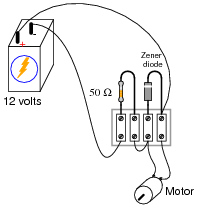
- Imotor = 20 mA ; Pzener =
- Imotor = 50 mA ; Pzener =
- Imotor = 90 mA ; Pzener =
- Imotor = 120 mA ; Pzener =
- Imotor = 150 mA ; Pzener =
Reveal answer- Imotor = 20 mA ; Pzener = 600 mW
- Imotor = 50 mA ; Pzener = 450 mW
- Imotor = 90 mA ; Pzener = 250 mW
- Imotor = 120 mA ; Pzener = 100 mW
- Imotor = 150 mA ; Pzener = 0 mW
Follow-up question: is load voltage maintained at 5 volts constant throughout this range of load currents (from 20 mA to 150 mA)?
Notes:The follow-up question is fairly important here, as students need to realize the limitations of zener-based voltage regulators. Most importantly, are they able to calculate the exact current limit of a zener-based voltage regulator - the point at which it stops regulating?
It should be noted that the calculated answers shown here will not precisely match a real zener diode circuit, due to the fact that zener diodes tend to gradually taper off in current as the applied voltage nears the zener voltage rating rather than current sharply dropping to zero as a simpler model would predict.
-
Question 27 of 28
Is it possible to reduce this zener diode voltage regulator circuit to a Thévenin equivalent circuit? Explain why or why not.
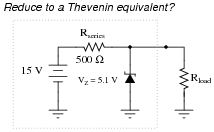
Reveal answerTechnically, this circuit cannot be reduced to either a Thévenin or Norton equivalent, because the zener diode is a nonlinear component. However, it is possible to create two different Thévenin equivalent circuits: one representing the circuit when regulating voltage at Vzener, and the other representing the circuit when the load resistance is below the critical value and the voltage is no longer being regulated:
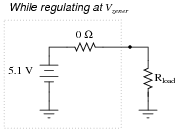
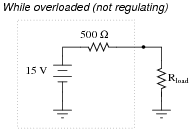
Notes:Some students may protest at the first Thévenin equivalent circuit (with a 0 ohm series resistance), because this would be a perfect voltage source. In reality, there would be a very small series resistance accounting for the slight voltage “sag” experienced under changing loads within the regulation range, but this is difficult to calculate.