Facebook
 Google
 GitHub
 Linkedin
Discrete Semiconductor Devices and Circuits
Regulated Power Sources
28 questions By Tony R. Kuphaldt
-
Question 10 of 28
Calculate the approximate amount of current this current mirror circuit will try to maintain through Rload, assuming silicon transistors (0.7 volts forward base-emitter junction drop):
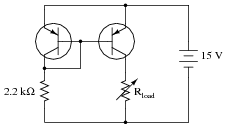
Reveal answerIload ≈ 6.5 mA
Follow-up question: what would have to be changed in this circuit to increase the amount of current through the load resistor without changing the power supply voltage?
Notes:Ask your students to explain how they obtained the answer to this question, step by step.
-
Question 11 of 28
Calculate the approximate amount of current this current mirror circuit will try to maintain through Rload, assuming silicon transistors (0.7 volts forward base-emitter junction drop):
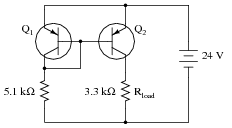
Also, calculate the approximate power dissipation of transistor Q2.
Reveal answerIload ≈ 4.57 mA PQ2 ≈ 40.77 mW
Notes:Ask your students to explain how they obtained the answer to this question, step by step.
-
Question 12 of 28
Calculate the approximate amount of current this current mirror circuit will try to maintain through Rload, assuming silicon transistors (0.7 volts forward base-emitter junction drop):
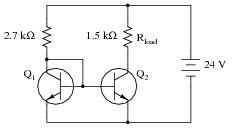
Also, calculate the approximate power dissipation of both transistors.
Reveal answerIload ≈ 8.63 mA PQ1 ≈ 6.041 mW PQ2 ≈ 95.41 mW
Follow-up question: what do the two power dissipation figures tell us about the relative power of two transistors handling the exact same currents? Explain why this is important in a current mirror circuit, and why it is customary to thermally bond Q1 and Q2 together in discrete-component current mirrors.
Notes:Ask your students to explain how they obtained the answer to this question, step by step.
The follow-up question is an important one for a few reasons. First, students must be aware that transistor power dissipation is determined by more than just collector current. Secondly, the disparate dissipations of these two transistors will lead to inaccuracies in regulated current in a current mirror circuit if measures are not taken to equalize their temperatures.