Facebook
 Google
 GitHub
 Linkedin
AC Electric Circuits
Passive Filter Circuits
44 questions By Tony R. Kuphaldt
-
Question 40 of 44
Suppose that the following audio tone control circuit has a problem: the second potentiometer (Rpot2) seems to act more like a plain volume control than a tone control. Instead of adjusting the amount of treble heard at the headphones, it seems to adjust the volume of bass and treble tones alike:

What do you think might be wrong with this circuit? Assuming it has been correctly designed and was working well for some time, what component or wire failure could possibly account for this behavior?
Reveal answerMost likely capacitor C1 has failed shorted.
Notes:Discuss with your students how this circuit functions before they offer their ideas for faulted components or wires. One must understand the basic operating principle(s) of a circuit before one can troubleshoot it effectively!
-
Question 41 of 44
Suppose that the following audio tone control circuit has a problem: the first potentiometer (Rpot1) seems to act more like a plain volume control than a tone control. Instead of adjusting the amount of bass heard at the headphones, it seems to adjust the volume of bass and treble tones alike:

What do you think might be wrong with this circuit? Assuming it has been correctly designed and was working well for some time, what component or wire failure could possibly account for this behavior?
Reveal answerMost likely inductor L1 has failed shorted.
Notes:Discuss with your students how this circuit functions before they offer their ideas for faulted components or wires. One must understand the basic operating principle(s) of a circuit before one can troubleshoot it effectively!
-
Question 42 of 44
Controlling electrical “noise” in automotive electrical systems can be problematic, as there are many sources of “noise” voltages throughout a car. Spark ignitions and alternators can both generate substantial noise voltages, superimposed on the DC voltage in a car’s electrical system. A simple way to electrically model this noise is to draw it as an AC “noise voltage” source in series with the DC source. If this noise enters a radio or audio amplifier, the result will be an irritating sound produced at the speakers:
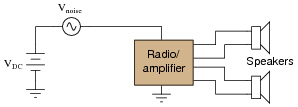
What would you suggest as a “fix” for this problem if a friend asked you to apply your electronics expertise to their noisy car audio system? Be sure to provide at least two practical suggestions.
Reveal answerThis is perhaps the easiest solution, to install a very large capacitor (Chuge) in parallel with the audio load:

Other, more sophisticated solutions exist, however!
Follow-up question: use superposition theorem to show why the capacitor mitigates the electrical noise without interfering with the transfer of DC power to the radio/amplifier.
Notes:The follow-up question is yet another example of how practical the superposition theorem is when analyzing filter circuits.