Facebook
 Google
 GitHub
 Linkedin
AC Electric Circuits
Passive Filter Circuits
44 questions By Tony R. Kuphaldt
-
Question 4 of 44
It is common in audio systems to connect a capacitor in series with each “tweeter” (high-frequency) speaker to act as a simple high-pass filter. The choice of capacitors for this task is important in a high-power audio system.
A friend of mine once had such an arrangement for the tweeter speakers in his car. Unfortunately, though, the capacitors kept blowing up when he operated the stereo at full volume! Tired of replacing these non-polarized electrolytic capacitors, he came to me for advice. I suggested he use mylar or polystyrene capacitors instead of electrolytics. These were a bit more expensive than electrolytic capacitors, but they did not blow up. Explain why.
Reveal answerThe issue here was not polarity (AC versus DC), because these were non-polarized electrolytic capacitors which were blowing up. What was an issue was ESR (Equivalent Series Resistance), which electrolytic capacitors are known to have high values of.
Notes:Your students may have to do a bit of refreshing (or first-time research!) on the meaning of ESR before they can understand why large ESR values could cause a capacitor to explode under extreme operating conditions.
-
Question 5 of 44
Suppose a friend wanted to install filter networks in the “woofer” section of their stereo system, to prevent high-frequency power from being wasted in speakers incapable of reproducing those frequencies. To this end, your friend installs the following resistor-capacitor networks:
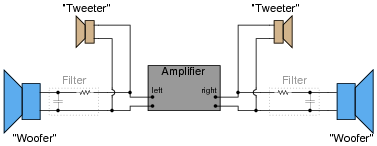
After examining this schematic, you see that your friend has the right idea in mind, but implemented it incorrectly. These filter circuits would indeed block high-frequency signals from getting to the woofers, but they would not actually accomplish the stated goal of minimizing wasted power.
What would you recommend to your friend in lieu of this circuit design?
Reveal answerRather than use a “shunting” form of low-pass filter (resistor and capacitor), a “blocking” form of low-pass filter (inductor) should be used instead.
Notes:The reason for this choice in filter designs is very practical. Ask your students to describe how a “shunting” form of filter works, where the reactive component is connected in parallel with the load, receiving power through a series resistor. Contrast this against a “blocking” form of filter circuit, in which a reactive component is connected in series with the load. In one form of filter, a resistor is necessary. In the other form of filter, a resistor is not necessary. What difference does this make in terms of power dissipation within the filter circuit?
-
Question 6 of 44
The superposition principle describes how AC signals of different frequencies may be “mixed” together and later separated in a linear network, without one signal distorting another. DC may also be similarly mixed with AC, with the same results.
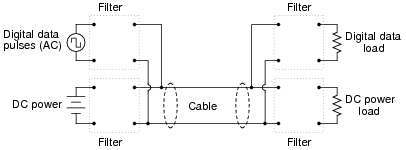
This phenomenon is frequently exploited in computer networks, where DC power and AC data signals (on-and-off pulses of voltage representing 1-and-0 binary bits) may be combined on the same pair of wires, and later separated by filter circuits, so that the DC power goes to energize a circuit, and the AC signals go to another circuit where they are interpreted as digital data:
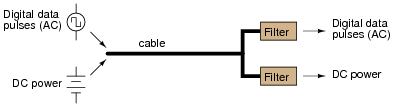
Filter circuits are also necessary on the transmission end of the cable, to prevent the AC signals from being shunted by the DC power supply’s capacitors, and to prevent the DC voltage from damaging the sensitive circuitry generating the AC voltage pulses.
Draw some filter circuits on each end of this two-wire cable that perform these tasks, of separating the two sources from each other, and also separating the two signals (DC and AC) from each other at the receiving end so they may be directed to different loads:
Reveal answer
Follow-up question #1: how might the superposition theorem be applied to this circuit, for the purposes of analyzing its function?
Follow-up question #2: suppose one of the capacitors were to fail shorted. Identify what effect, if any, this would have on the operation of the circuit. What if two capacitors were to fail shorted? Would it matter if those two capacitors were both on either the transmitting or the receiving side, or if one of the failed capacitors was on the transmitting side and the other was on the receiving side?
Notes:Discuss with your students why inductors were chosen as filtering elements for the DC power, while capacitors were chosen as filtering elements for the AC data signals. What are the relative reactances of these components when subjected to the respective frequencies of the AC data signals (many kilohertz or megahertz) versus the DC power supply (frequency = 0 hertz).
This question is also a good review of the “superposition theorem,” one of the most useful and easiest-to-understand of the network theorems. Note that no quantitative values need be considered to grasp the function of this communications network. Analyze it qualitatively with your students instead.