Facebook
 Google
 GitHub
 Linkedin
Discrete Semiconductor Devices and Circuits
Power Conversion Circuits
30 questions By Tony R. Kuphaldt
-
Question 19 of 30
Many switching converter circuits use a switched MOSFET in place of a free-wheeling diode, like this:
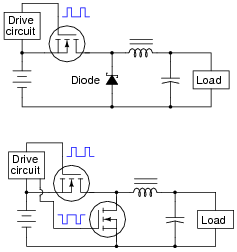
The diode is a simple solution for providing the inductor a path for current when the main switching transistor is off. Why would anyone use another MOSFET in place of it, especially if this means the drive circuit has to become more complex (to drive two transistors at different times instead of just one transistor) to do the same task?
Reveal answerA MOSFET in its enhanced mode will drop less voltage than a diode (even a Schottky diode) in this circuit, improving power efficiency.
Notes:It might not be obvious to some students why less voltage drop (across the MOSFET versus across the diode) has an impact on conversion efficiency. Remind them that power equals voltage times current, and that for any given current, a reduced voltage drop means reduced power dissipation. For the free-wheeling current path, less power dissipation means less power wasted, and less power that needs to be supplied by the source (for the same load power), hence greater efficiency.
-
Question 20 of 30
A “boost” switching converter operating at 90% efficiency delivers 50 volts to a DC load. Calculate the load current if the input voltage is 17 volts and the input current is 9.3 amps.
Reveal answerIload = 2.85 amps
Notes:Calculations involving energy efficiency seem very confusing to some students. One principle that I often remind my students of is the Law of Energy Conservation, which prohibits any circuit from outputting more energy (or power) than it takes in. All too often, students mis-calculate in problems such as these, ending up with output powers greater than input powers!
Discuss problem-solving techniques, soliciting input from your students. Ideally, have individuals or groups present their techniques to the class as a whole, so you may observe their thinking processes and so that other students may learn how to become better problem-solvers.
-
Question 21 of 30
A “buck” switching converter operating at 85% efficiency delivers 10 amps of current at 5 volts to a DC load. Calculate the input current if the input voltage is 23 volts.
Reveal answerIinput = 2.56 amps
Notes:Calculations involving energy efficiency seem very confusing to some students. One principle that I often remind my students of is the Law of Energy Conservation, which prohibits any circuit from outputting more energy (or power) than it takes in. All too often, students mis-calculate in problems such as these, ending up with output powers greater than input powers!
Discuss problem-solving techniques, soliciting input from your students. Ideally, have individuals or groups present their techniques to the class as a whole, so you may observe their thinking processes and so that other students may learn how to become better problem-solvers.