Facebook
 Google
 GitHub
 Linkedin
Discrete Semiconductor Devices and Circuits
Power Conversion Circuits
30 questions By Tony R. Kuphaldt
-
Question 25 of 30
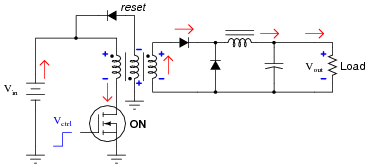
The following DC-DC converter circuit is called a forward converter. It is called this because the energy transfer from input to output occurs while the transistor is conducting, not while it is off. Verify this feature of the circuit by tracing current through all portions of it while the transistor is on:
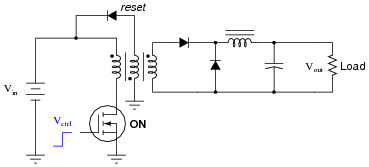
Now, trace current through the circuit while the transistor is off, and explain the purpose of the reset winding in the transformer:

Reveal answerIn the following schematics, conventional flow notation has been used to denote direction of currents:
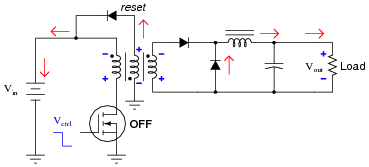
The purpose of the reset winding is to rid the transformer core of stored energy during the off cycle. If this were not done, the transformer core’s magnetic flux levels would reach saturation after just a few on/off cycles of the transistor.
Notes:This question is a great review of the “dot convention” used in transformer schematic symbols.
-
Question 26 of 30
While simple “brute-force” AC-DC power supply circuits (transformer, rectifier, filter, regulator) are still used in a variety of electronic equipment, another form of power supply is more prevalent in systems where small size and efficiency are design requirements. This type of power supply is called a switching power supply.
Explain what a “switching power supply” is, and provide a schematic diagram of one for presentation and discussion. (Hint: most electronic computers use “switching” power supplies instead of “brute force” power supplies, so schematic diagrams should not be difficult to find.)
Reveal answerI’ll let you do all the research for this question!
Notes:While many “switching” power supply circuits will be too complex for beginning electronics students to fully understand, it will still be a useful exercise to analyze such a schematic and identify the major components (and functions).
Ask your students why “switching” power supplies are smaller and more efficient than “brute force” designs. Ask your students to note the type of transformer used in switching power supplies, and contrast its construction to that of line-frequency power transformers.
-
Question 27 of 30
Suppose a friend of yours recently purchased an off-road vehicle. This friend also purchased a military-surplus spotlight, which he thinks would be a great accessory for off-road illumination at night. The only problem is, the spotlight is rated for 24 volts, while the electrical system in his vehicle is 12 volt.
Your friend asks you to engineer a solution for powering the 24-volt spotlight with the 12 volts available on his vehicle. Of course, you are not allowed to modify the vehicle’s electrical system (change it to 24 volt generator, battery, starter motor, etc.), because it is new and still under warranty. What do you recommend to your friend?
Draw a component-level schematic diagram of your solution to this problem.
Reveal answerWhile there are several different methods which could be used here to transform 12 volts into 24 volts, I will not reveal any of them here, lest I spoil the fun for you!
Notes:Students may be inclined to give easy answers to this problem (“use a DC-DC converter!”), but the purpose of it is for students to explore solutions at the component level. Even if they do not yet understand how the circuitry works, they should be able to find complete solutions in their research, or at least enough schematics for sections of the conversion process for them to engineer a complete solution.
Remind your students that this is a powerful spotlight they’re going to have to power! Their conversion system may have to handle hundreds of watts.