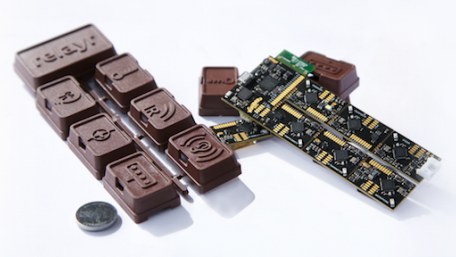
Learn how to set up the Wunderbar platform to begin building your own IoT apps. This will demonstrate the "Can't Touch This" and "Tell Me When" demo applications…
Learn how to set up the Wunderbar platform to begin building your own IoT apps. This will demonstrate the "Can't Touch This" and "Tell Me When" demo applications to measure WunderBar sensors and perform actions based on them. Some of the major bugs are discussed.

Create a smart home by displaying the current salt level of your water softener with the CC3200 and a proximity sensor.
Create a smart home by displaying the current salt level of your water softener with the CC3200 and a proximity sensor.

Part 4 in the “How to Make an Ambient Light Monitor” series
Part 4 in the “How to Make an Ambient Light Monitor” series

Building on skills developed in the introductory KiCad tutorial, this article will focus on creating custom parts and…
Building on skills developed in the introductory KiCad tutorial, this article will focus on creating custom parts and adding them to a local library, expanding the default libraries to include community repositories, and contributing parts back into the open source ecosystem. The end product will be a MAX31855 K-type thermocouple amplifier which can be used for a huge array of temperature sensing projects.

Detect audio with an electret microphone and a TI CC3200 Wifi microcontroller. This handy project will allow you to set…
Detect audio with an electret microphone and a TI CC3200 Wifi microcontroller. This handy project will allow you to set up an audio detection device that can be used to catch your roommate stealing things from the fridge or send you an alert if the noise in your room goes above a certain threshold.

How to read humidity and temperature from a DHT11 and display it on a LCD with a PIC microcontroller. In this example…
How to read humidity and temperature from a DHT11 and display it on a LCD with a PIC microcontroller. In this example we're going to use a PIC16F628A.

Part 2 in the "How to Make an Ambient Light Monitor" Series. Our smart ambient light monitor will need to digitize and…
Part 2 in the "How to Make an Ambient Light Monitor" Series. Our smart ambient light monitor will need to digitize and analyze signals from an optical detector, so it is time to explore the EFM8’s integrated analog-to-digital conversion functionality.

Part 3 in the “How to Make an Ambient Light Monitor” series. The project continues by building an ambient light…
Part 3 in the “How to Make an Ambient Light Monitor” series. The project continues by building an ambient light sensor circuit on a breadboard, digitizing the circuit’s output signals, and interpreting the digitized measurements.

How to interface a Raspberry Pi to an I2C temperature sensor (TMP102) and then publish the data to a Google sheet and graph.
How to interface a Raspberry Pi to an I2C temperature sensor (TMP102) and then publish the data to a Google sheet and graph.

Learn how to use an EFM8 microcontroller to convert current and voltage measurements to digits that can be displayed on…
Learn how to use an EFM8 microcontroller to convert current and voltage measurements to digits that can be displayed on an LCD. We'll discuss a convenient way to report analog-to-digital conversion values that represent current and voltage amplitudes.

Learn how to connect your device with Linux Screen using the built-in Lua interpreter to set up the file system and…
Learn how to connect your device with Linux Screen using the built-in Lua interpreter to set up the file system and connect to the network. Then, learn how to automate the scripting process with Luatool and put it all together with a basic TCP server that can interact with a pulse-width modulated LED, a potentiometer, and a switch.

Compile and install NodeMCU on the ESP8266 IoT chip using Linux tools and the ESP Open Source SDK
Compile and install NodeMCU on the ESP8266 IoT chip using Linux tools and the ESP Open Source SDK

Introduction to the Arduino SPI Library with example sketch for the LTC1286 12 Bit ADC and the DAC714 16 bit DAC.
Introduction to the Arduino SPI Library with example sketch for the LTC1286 12 Bit ADC and the DAC714 16 bit DAC.

The 08M2 is the smallest member of the PICAXE family of microcontrollers; it is inexpensive, versatile, and easy to…
The 08M2 is the smallest member of the PICAXE family of microcontrollers; it is inexpensive, versatile, and easy to program using free software.

Since different colors reflect different levels of light, you can use a photoresistor or a phototransistor to sense…
Since different colors reflect different levels of light, you can use a photoresistor or a phototransistor to sense different colors.

The ease with which an Arduino can obtain sensor values is one of the features that makes it so useful.
The ease with which an Arduino can obtain sensor values is one of the features that makes it so useful.

An infrared (IR) light sensor allows the use of an Arduino to receive and decode signals from a TV remote control.
An infrared (IR) light sensor allows the use of an Arduino to receive and decode signals from a TV remote control.

Infrared (IR) sensors are normally used to measure distances, but they can also be used to detect objects. By connecting…
Infrared (IR) sensors are normally used to measure distances, but they can also be used to detect objects. By connecting a couple of IR sensors to an Arduino, you can make an intruder alarm.

Monitoring the output of a light-dependent resistor, or photoresistor, allows the Arduino to know how light or dark it…
Monitoring the output of a light-dependent resistor, or photoresistor, allows the Arduino to know how light or dark it is. When the light falls below a certain level, the Arduino turns on a couple of LEDs.


 Facebook
 Google
 GitHub
 Linkedin