
 Facebook
 Google
 GitHub
 Linkedin
AC Electric Circuits
AC Power
47 questions By Tony R. Kuphaldt
-
Question 43 of 47
In AC power systems, a common way of thinking about reactive power among engineers is in terms of production and consumption. Inductive loads, it is said, consume reactive power. Conversely, capacitive loads produce reactive power.
Explain how the models of “production” and “consumption” relate to reactive power in capacitors and inductors, respectively. Being that neither type of component actually dissipates or generates electrical energy, how can these terms be appropriate in describing their behavior?
Reveal answerIt is true that inductors and capacitors alike neither dissipate nor generate electrical energy. They do, however, store and release energy. And they do so in complementary fashion, inductors storing energy at the same time that capacitors release, and visa-versa.
Part of the answer to this question lies in the fact that most large AC loads are inductive in nature. From a power plant’s perspective, the reactive power of a customer (a “consumer” of power) is inductive in nature, and so that form of reactive power would naturally be considered “consumption.”
Notes:Ask your students this question: if customers on an electrical system “consume” reactive power, then who has the job of supplying it? Carrying this question a bit further, are the alternators used to generate power rated in watts or in volt-amps? Is it possible for an alternator to supply an infinite amount of purely reactive power, or is there some kind of limit inherent to the device? To phrase the question another way, does the necessity of “supplying” reactive power to customers limit the amount of true power than a power plant may output?
-
Question 44 of 47
Another name for “capacitor” is condenser. Explain what a synchronous condenser is, and how it is used to correct power factor in AC power systems.
Reveal answerA “synchronous condenser” is a special type of AC electric motor that happens to have a variable power factor. They are used as variable capacitors to correct for changing power factors.
Challenge question: capacitors are considered reactive devices because they have to ability to store and release energy. How would a synchronous condenser store and release energy, seeing as it does not make use of electric fields as capacitors do?
Notes:There is a fair amount of information available on the internet and also in power engineering texts on the subject of synchronous condensers, although this mature technology is being superseded by solid-state static VAR compensator circuits which have no moving parts.
You might wish to mention that most AC generators (alternators) have the ability to run as synchronous motors, and therefore as synchronous condensers. It is commonplace for spare generators at power plants to be “idled” as electric motors and used to generate leading VARs to reduce heating in the windings of the other generators. This is especially true at hydroelectric dams, where frequent shut-downs and start-ups of generator units is discouraged due to the massive size of the units and the physical wear incurred during that cycling.
-
Question 45 of 47
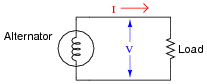
Calculating apparent power for a single-phase AC circuit is easy - simply multiply line voltage by line current (S = VI):
How do we calculate apparent power in a balanced three-phase circuit, given the same figures?
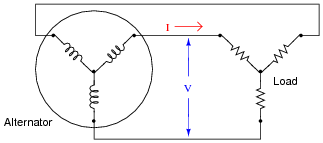
Reveal answerS = √3(VI)
Follow-up question: suppose the three-phase system were a Delta configuration instead of a Wye configuration. Does this influence the apparent power calculation? Why or why not?
Notes:The formula for calculating power in a balanced three-phase system may be found in any textbook. Let your students do the necessary research!


