
 Facebook
 Google
 GitHub
 Linkedin
AC Electric Circuits
AC Power
47 questions By Tony R. Kuphaldt
-
Question 40 of 47
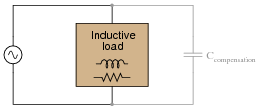
If an AC circuit has a lagging power factor, the way to correct for that power factor is to add a capacitor to the circuit to create leading reactive power. This leading reactive power will cancel the lagging reactive power of the load, ideally negating one another so that there is no reactive power demands placed on the source (zero net reactive power in the circuit):
Define a step-by-step procedure for calculating the size of compensating capacitor needed (in Farads) in order to correct any lagging power factor to a value of unity. Make your procedure general enough that it may apply to any scenario.
Reveal answerI’ll let you determine your own procedure, based on the steps you had to take to correct power factor in other questions!
- Power factor correction calculation procedure
- •
- •
- •
- •
- •
- •
Notes:Students generally do not like to explain procedures. They would much rather follow a procedure given by an Authority, because it requires less thinking. It is your responsibility as their instructor to enforce the requirement for thinking in the classroom. It serves your students little to provide them with step-by-step instructions on how to calculate certain things, because ultimately their success will depend on their ability to think deeply and critically, and to problem-solve all on their own.
Answering this question in a group discussion setting need not be intimidating. You may choose to have groups of students answer this question instead of just one or two, or you may even assign this question specifically to a group of students so that there is the impetus of shared responsibility and the safety of friendly assistance in finding an answer.
-
Question 41 of 47
Most methods of power factor correction involve the connection of a parallel capacitance to an inductive load:

It is technically possible to correct for lagging power factor by connecting a capacitor in series with an inductive load as well, but this is rarely done:
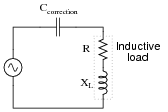
Explain why series capacitance is not considered a practical solution for power factor correction in most applications.
Reveal answerThis is essentially a series-resonant circuit, with all the inherent dangers of series resonance (I’ll let you review what those dangers are!).
Follow-up question: aside from safety, there is also the matter of reliability that concerns us. Examine the parallel-capacitor circuit and the series-capacitor circuit from the perspective of a failed capacitor. Explain how each type of capacitor failure (open versus short) will affect these two circuits.
Notes:Not only would a series-resonant power circuit be dangerous, but it would also require capacitors rated for handling large continuous currents. The equivalent series resistance (ESR) of the capacitor would have to be very low in order to not experience problems handling full load current for extended periods of time.
It should be mentioned that series capacitors sometimes are used in power systems, most notably at the connection points of some high-voltage distribution lines, at the substation(s).
-
Question 42 of 47
Although most high-power AC loads are inductive in nature, some are capacitive. Explain what you would have to do to correct for the leading power factor of a large capacitive load, provided the power factor were low enough to warrant the expense of equipment to correct it.
Reveal answerIf inductive loads have their low power factors corrected by the addition of parallel capacitors, the solution to correcting low power factor for a capacitive load should be easy to identify. I’ll let you figure out the answer to this!
Challenge question: explain how you could exploit the inductive nature of electric motors and other more common load devices in correcting for an excessively low leading power factor.
Notes:If some students fail to understand the answer to this question, try drawing an “upside-down” power triangle to illustrate:


