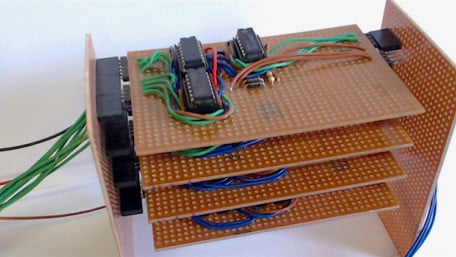
In this project, we will build the heart of a simple 4-bit CPU, the ALU (Arithmetic Logic Unit).
In this project, we will build the heart of a simple 4-bit CPU, the ALU (Arithmetic Logic Unit).

In part 8 of the "Building Raspberry Pi Controller" series, readers will learn how to attach a camera board to a…
In part 8 of the "Building Raspberry Pi Controller" series, readers will learn how to attach a camera board to a Raspberry Pi and write Python code for photo imaging projects.

In this project, you'll learn how to build a 4-bit binary counter using a 5x7 LED matrix for data count value…
In this project, you'll learn how to build a 4-bit binary counter using a 5x7 LED matrix for data count value visualization. The project will use a combination of standard electronic and surface mount components.

Learn how to build a system that can turn DC loads on and off using a mobile application. You'll also learn how to…
Learn how to build a system that can turn DC loads on and off using a mobile application. You'll also learn how to perform this task via immediate actions or via timers set in advance.

Over-voltage and over-current protection circuit for use with the C-BISCUIT platform's main computer, the Wandboard.
Over-voltage and over-current protection circuit for use with the C-BISCUIT platform's main computer, the Wandboard.

No I2C interface with that sensor? No problem. Program a PIC chip as an I2C slave device for custom sensor and I/O…
No I2C interface with that sensor? No problem. Program a PIC chip as an I2C slave device for custom sensor and I/O interfacing. Here, we use three DHT22 sensors on a single I2C interface.

While the C-BISCUIT project is far from complete, it's already come a long way, seeing numerous ideas and design goals in…
While the C-BISCUIT project is far from complete, it's already come a long way, seeing numerous ideas and design goals in the process. This article will discuss some of these.

Invoke the power of the PID (proportional–integral–derivative controller)! The key components in this design are an…
Invoke the power of the PID (proportional–integral–derivative controller)! The key components in this design are an EFM8 microcontroller, a DAC, and the MAX31855 thermocouple-to-digital converter.

This project explains how to isolate signals to eliminate ground loops in electronic systems.
This project explains how to isolate signals to eliminate ground loops in electronic systems.

Gather data via USB from a BH1745NUC optical sensor and then display color characteristics and illuminance values.
Gather data via USB from a BH1745NUC optical sensor and then display color characteristics and illuminance values.

Learn how to collect and process RGB data generated by the BH1745NUC color sensor IC.
Learn how to collect and process RGB data generated by the BH1745NUC color sensor IC.

Display colors by precisely controlling the intensity of red, green, and blue LEDs.
Display colors by precisely controlling the intensity of red, green, and blue LEDs.

Tips and techniques for incorporating EFM8 microcontrollers into your custom hardware.
Tips and techniques for incorporating EFM8 microcontrollers into your custom hardware.

An FPGA is a crucial tool for many DSP and embedded systems engineers. However, the learning curve when getting started…
An FPGA is a crucial tool for many DSP and embedded systems engineers. However, the learning curve when getting started can be fairly steep. This project introduces the Quartus II and ModelSim software suites as well as a background on FPGA design flow for system on chip development. The development board used was a Terasic DE1-SoC, which has the Altera Cyclone V SoC chip. This IC contains an FPGA and an integrated ARM Cortex A9 as a hard processor system.

Take a few minutes to characterize a light dependent resistor (LDR) and you can build a simple and reasonably accurate…
Take a few minutes to characterize a light dependent resistor (LDR) and you can build a simple and reasonably accurate light meter can be built using an LDR and an Arduino.

In the last installment, we built the hardware to control an AC waveform with a TRIAC as the first step in a DIY solder…
In the last installment, we built the hardware to control an AC waveform with a TRIAC as the first step in a DIY solder reflow oven. This tutorial continues the project by showing you how to set up the low-level hardware to measure temperature, read the zero-cross detector, drive the TRIAC, and print to the serial terminal using a USART.

Connecting a PICAXE to the IoT through an ESP8266 module is easy once you know the process. Here are the details you need!
Connecting a PICAXE to the IoT through an ESP8266 module is easy once you know the process. Here are the details you need!

Part two of a series of articles on building a robot that can follow lines or walls and avoid obstacles! This time we'll…
Part two of a series of articles on building a robot that can follow lines or walls and avoid obstacles! This time we'll be covering PCB design.

Part one of a series of articles on building a robot that can follow lines or walls and avoid obstacles!
Part one of a series of articles on building a robot that can follow lines or walls and avoid obstacles!

Updating the firmware in an ESP8266 Wi-Fi module can be frustrating! Here's a procedure to reduce the pain.
Updating the firmware in an ESP8266 Wi-Fi module can be frustrating! Here's a procedure to reduce the pain.


 Facebook
 Google
 GitHub
 Linkedin