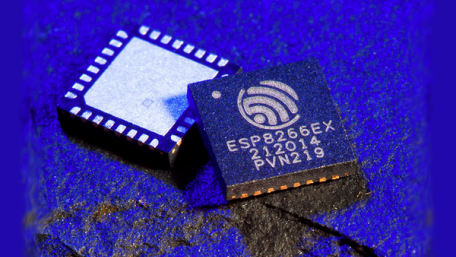
The ESP8266 combination microcontroller/Wi-Fi modules can now be programmed using the Arduino IDE. Here's how!
The ESP8266 combination microcontroller/Wi-Fi modules can now be programmed using the Arduino IDE. Here's how!

In this article I will show you how to use the internal EEPROM of an ATMega 328P microcontroller. I will use a…
In this article I will show you how to use the internal EEPROM of an ATMega 328P microcontroller. I will use a USB-to-serial converter, and an LM35 temperature sensor. I will also give you some tips and tricks when designing a PCB.

Two evaluation boards from IDT help you to quickly and conveniently integrate wireless power into your designs.
Two evaluation boards from IDT help you to quickly and conveniently integrate wireless power into your designs.

An inexpensive PICAXE microcontroller makes it easy to read a temperature sensor, compare the temperature to a setpoint,…
An inexpensive PICAXE microcontroller makes it easy to read a temperature sensor, compare the temperature to a setpoint, and turn a heater or cooler circuit on or off.

Build your own TDR out of a scope and a signal generator to troubleshoot long cable runs and impedance mismatches.
Build your own TDR out of a scope and a signal generator to troubleshoot long cable runs and impedance mismatches.

Control a fan based on the current temperature with a Raspberry Pi!
Control a fan based on the current temperature with a Raspberry Pi!

Teaming up a PICAXE µC, a DS1307 real time clock module, and an LCD117 serial adapter with a liquid crystal display is…
Teaming up a PICAXE µC, a DS1307 real time clock module, and an LCD117 serial adapter with a liquid crystal display is a fun, educational way to assemble your own date and time demo.

Create a wireless "relative comfort" light bar thermometer by broadcasting temperature data across multiple ESP8266…
Create a wireless "relative comfort" light bar thermometer by broadcasting temperature data across multiple ESP8266 modules running NodeMCU using MQTT.

How to add BLE capabilities to a wireless ceiling fan by incorporating the nRF51 in the remote control. Part of our…
How to add BLE capabilities to a wireless ceiling fan by incorporating the nRF51 in the remote control. Part of our series on the nRF51.

A tutorial for the Arduino Motor Shield with a simple project. The motor shield has quite a few features such as current…
A tutorial for the Arduino Motor Shield with a simple project. The motor shield has quite a few features such as current measuring and the ability to drive a single stepper motor.

Adding variable speed control and battery monitoring to a Power Wheels truck!
Adding variable speed control and battery monitoring to a Power Wheels truck!

Part 2 in the “How to Make an EFM8-Based Sound Synthesizer” series.
Part 2 in the “How to Make an EFM8-Based Sound Synthesizer” series.

Part 1 in the “How to Make an EFM8-Based Sound Synthesizer” series, which will design a sound synthesizer that can…
Part 1 in the “How to Make an EFM8-Based Sound Synthesizer” series, which will design a sound synthesizer that can play standard musical notes. We will accomplish this using a low-cost, small-form-factor EFM8 microcontroller in conjunction with a few external components and a speaker.

Getting started with PSoC®, the Programmable-System-on-Chip by Cypress Semiconductor for developing and testing embedded systems.
Getting started with PSoC®, the Programmable-System-on-Chip by Cypress Semiconductor for developing and testing embedded systems.

This is one simple way to control a LED, fan, relay or solenoid with a computer and a PIC.
This is one simple way to control a LED, fan, relay or solenoid with a computer and a PIC.

You and your friends are planning the greatest party your hometown has ever seen. Just one problem: you don't have a…
You and your friends are planning the greatest party your hometown has ever seen. Just one problem: you don't have a karaoke system. What's a great party with no karaoke? We're about to fix that. All you need are a few potentiometers and an op-amp.

Part 3 in the “How to Make an Ambient Light Monitor” series. The project continues by building an ambient light…
Part 3 in the “How to Make an Ambient Light Monitor” series. The project continues by building an ambient light sensor circuit on a breadboard, digitizing the circuit’s output signals, and interpreting the digitized measurements.

How to interface a Raspberry Pi to an I2C temperature sensor (TMP102) and then publish the data to a Google sheet and graph.
How to interface a Raspberry Pi to an I2C temperature sensor (TMP102) and then publish the data to a Google sheet and graph.

The LM35 is an ideal temperature sensor for measuring ambient temperature. It provides a linear output proportional to…
The LM35 is an ideal temperature sensor for measuring ambient temperature. It provides a linear output proportional to the temperature, with 0 V corresponding to 0 degrees C and an output voltage change of 10 mV for each degree C change. LM35s are easier to use than thermistors and thermocouples because they are so linear and require no signal conditioning.

The ease with which an Arduino can obtain sensor values is one of the features that makes it so useful.
The ease with which an Arduino can obtain sensor values is one of the features that makes it so useful.


 Facebook
 Google
 GitHub
 Linkedin