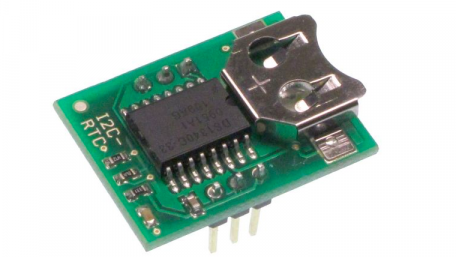
This article will show you one way of making an accurate clock by using the Real Time Clock IC DS1307. The time will be shown on a LCD display.
This article will show you one way of making an accurate clock by using the Real Time Clock IC DS1307. The time will be shown on a LCD display.

How to create a custom BLE GATT peripheral using the nRF51 by creating a service and characteristics.
How to create a custom BLE GATT peripheral using the nRF51 by creating a service and characteristics.

Learn how to communicate with a custom BLE peripheral using an Android device.
Learn how to communicate with a custom BLE peripheral using an Android device.

LCDs are great for showing info from your microcontroller. A serial adapter is inexpensive, uses only one I/O, and is…
LCDs are great for showing info from your microcontroller. A serial adapter is inexpensive, uses only one I/O, and is easy to connect and to use.

Part 3 in the “How to Make an EFM8-Based Sound Synthesizer” series.
Part 3 in the “How to Make an EFM8-Based Sound Synthesizer” series.

MQ Telemetry Transport (MQTT) is a popular low-overhead messaging protocol used by many IoT devices to communicate. This…
MQ Telemetry Transport (MQTT) is a popular low-overhead messaging protocol used by many IoT devices to communicate. This tutorial will show the user how to to set up a basic MQTT network using Python on his or her computer and an ESP8266 running the NodeMCU firmware.

How to set up the build environment for the nRF51 system-on-chip using makefiles and ARM-GCC.
How to set up the build environment for the nRF51 system-on-chip using makefiles and ARM-GCC.

Part 2 in the “How to Make an EFM8-Based Sound Synthesizer” series.
Part 2 in the “How to Make an EFM8-Based Sound Synthesizer” series.

Part 1 in the “How to Make an EFM8-Based Sound Synthesizer” series, which will design a sound synthesizer that can…
Part 1 in the “How to Make an EFM8-Based Sound Synthesizer” series, which will design a sound synthesizer that can play standard musical notes. We will accomplish this using a low-cost, small-form-factor EFM8 microcontroller in conjunction with a few external components and a speaker.

Part 5 in the “How to Make an Ambient Light Monitor” series.
Part 5 in the “How to Make an Ambient Light Monitor” series.

Learn how to set up the Wunderbar platform to begin building your own IoT apps. This will demonstrate the "Can't Touch…
Learn how to set up the Wunderbar platform to begin building your own IoT apps. This will demonstrate the "Can't Touch This" and "Tell Me When" demo applications to measure WunderBar sensors and perform actions based on them. Some of the major bugs are discussed.

Getting started with PSoC®, the Programmable-System-on-Chip by Cypress Semiconductor for developing and testing embedded systems.
Getting started with PSoC®, the Programmable-System-on-Chip by Cypress Semiconductor for developing and testing embedded systems.

Create a smart home by displaying the current salt level of your water softener with the CC3200 and a proximity sensor.
Create a smart home by displaying the current salt level of your water softener with the CC3200 and a proximity sensor.

Beaglebone Black is the most recent incarnation of the Beaglebone open source hardware platform. For less than $50, the…
Beaglebone Black is the most recent incarnation of the Beaglebone open source hardware platform. For less than $50, the board includes Ethernet, graphics processing, 4Gb of nonvolatile storage, and ports supporting USB, HDMI, and Beaglebone's custom I/O add-ons, called "capes". Here's how to run some simple commands to toggle digital I/O on the board!

Part 4 in the “How to Make an Ambient Light Monitor” series
Part 4 in the “How to Make an Ambient Light Monitor” series

This is one simple way to control a LED, fan, relay or solenoid with a computer and a PIC.
This is one simple way to control a LED, fan, relay or solenoid with a computer and a PIC.

Detect audio with an electret microphone and a TI CC3200 Wifi microcontroller. This handy project will allow you to set…
Detect audio with an electret microphone and a TI CC3200 Wifi microcontroller. This handy project will allow you to set up an audio detection device that can be used to catch your roommate stealing things from the fridge or send you an alert if the noise in your room goes above a certain threshold.

How to read humidity and temperature from a DHT11 and display it on a LCD with a PIC microcontroller. In this example…
How to read humidity and temperature from a DHT11 and display it on a LCD with a PIC microcontroller. In this example we're going to use a PIC16F628A.

Part 2 in the "How to Make an Ambient Light Monitor" Series. Our smart ambient light monitor will need to digitize and…
Part 2 in the "How to Make an Ambient Light Monitor" Series. Our smart ambient light monitor will need to digitize and analyze signals from an optical detector, so it is time to explore the EFM8’s integrated analog-to-digital conversion functionality.

Part 3 in the “How to Make an Ambient Light Monitor” series. The project continues by building an ambient light…
Part 3 in the “How to Make an Ambient Light Monitor” series. The project continues by building an ambient light sensor circuit on a breadboard, digitizing the circuit’s output signals, and interpreting the digitized measurements.


 Facebook
 Google
 GitHub
 Linkedin