Facebook
 Google
 GitHub
 Linkedin
Discrete Semiconductor Devices and Circuits
Performance-Based Assessments for Semiconductor Circuit Competencies
62 questions By Tony R. Kuphaldt
-
Question 34 of 62

Reveal answerUse circuit simulation software to verify your predicted and measured parameter values.
Notes:Use a variable-voltage, regulated power supply to supply any amount of DC voltage below 30 volts. Specify standard resistor values, all between 1 kΩ and 100 kΩ (1k5, 2k2, 2k7, 3k3, 4k7, 5k1, 6k8, 10k, 22k, 33k, 39k 47k, 68k, etc.). Use a sine-wave function generator to supply an audio-frequency input signal, about 0.5 volts AC (peak).
Resistor values I have found practical are 10 kΩ for RC and 2.2 kΩ for RE. This gives a voltage gain of 4.545, and quiescent current values that are well within the range of common small-signal transistors.
An important aspect of this performance assessment is that students know what to do with the potentiometer. It is their responsibility to configure the circuit so that it operates in each mode (Class-A, Class-B, and Class-C).
An extension of this exercise is to incorporate troubleshooting questions. Whether using this exercise as a performance assessment or simply as a concept-building lab, you might want to follow up your students’ results by asking them to predict the consequences of certain circuit faults.
-
Question 35 of 62
Reveal answerUse circuit simulation software to verify your predicted and measured parameter values.
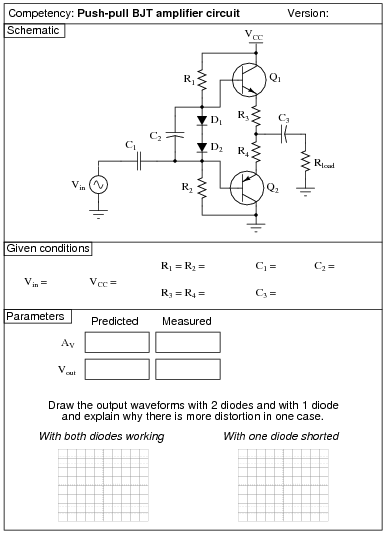
Notes:Use a variable-voltage, regulated power supply to supply any amount of DC voltage below 30 volts. Specify standard resistor values, all between 1 kΩ and 100 kΩ (1k5, 2k2, 2k7, 3k3, 4k7, 5k1, 6k8, 10k, 22k, 33k, 39k 47k, 68k, etc.). Use a sine-wave function generator to supply an audio-frequency input signal, and make sure its amplitude isn’t set so high that the amplifier clips.
I have had good success using the following values:
- VCC = 6 volts
- Vin = 1 volt (peak)
- R1 = R2 = 10 kΩ
- R3 = R4 = 10 Ω
- C1 = 0.47 μF
- C2 = 10 μF
- C3 = 47 μF
- D1 = D2 = part number 1N4001
- Q1 = part number 2N2222
- Q2 = part number 2N2907
An extension of this exercise is to incorporate troubleshooting questions. Whether using this exercise as a performance assessment or simply as a concept-building lab, you might want to follow up your students’ results by asking them to predict the consequences of certain circuit faults.
-
Question 36 of 62

Reveal answerUse circuit simulation software to verify your predicted and measured parameter values.
Notes:I’ve experienced good results using the following component values:
- VCC = 12 volts
- R1 = 220 kΩ
- R2 = 27 kΩ
- R3 = 10 kΩ
- R4 = 1.5 kΩ
- R5 = 1 kΩ
- C1 = 0.47 μF
- C2 = 4.7 μF
- C3 = 33 μF
- C4 = 47 μF
- Q1 and Q2 = 2N3403
Students have a lot of fun connecting long lengths of cable between the output stage and the speaker, and using this circuit to talk (one-way, simplex communication) between rooms.
One thing I’ve noticed some students misunderstand in their study of electronic amplifier circuits is their practical purpose. So many textbooks emphasize abstract analysis with sinusoidal voltage sources and resistive loads that some of the real applications of amplifiers may be overlooked by some students. One student of mine in particular, when building this circuit, kept asking me, ßo where does the signal generator connect to this amplifier?” He was so used to seeing signal generators connected to amplifier inputs in his textbook (and lab manual!) that he never realized you could use an amplifier circuit to amplify a real, practical audio signal!!! An extreme example, perhaps, but real nevertheless, and illustrative of the need for practical application in labwork.
In order for students to measure the voltage gain of this amplifier, they must apply a steady, sinusoidal signal to the input. The microphone and speaker are indeed practical, but the signals produced in such a circuit are too chaotic for students to measure with simple test equipment.
An extension of this exercise is to incorporate troubleshooting questions. Whether using this exercise as a performance assessment or simply as a concept-building lab, you might want to follow up your students’ results by asking them to predict the consequences of certain circuit faults.