Facebook
 Google
 GitHub
 Linkedin
Discrete Semiconductor Devices and Circuits
Performance-Based Assessments for Semiconductor Circuit Competencies
62 questions By Tony R. Kuphaldt
-
Question 19 of 62
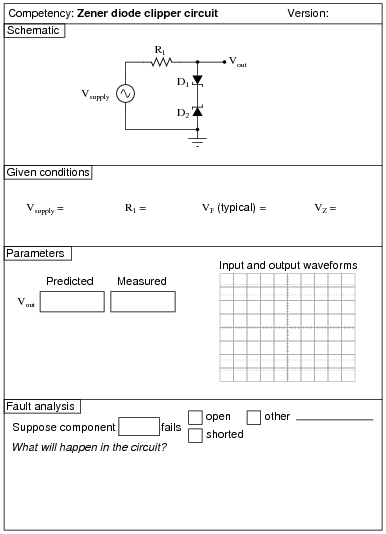
Reveal answerUse circuit simulation software to verify your predicted and measured parameter values.
Notes:Be sure to use zener diodes with reasonably low breakdown voltages, and specify the source voltage accordingly.
An extension of this exercise is to incorporate troubleshooting questions. Whether using this exercise as a performance assessment or simply as a concept-building lab, you might want to follow up your students’ results by asking them to predict the consequences of certain circuit faults.
-
Question 20 of 62
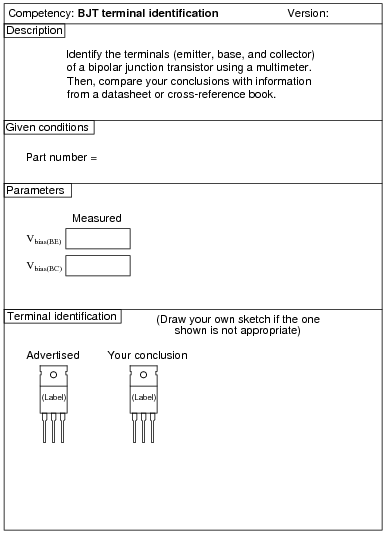
Reveal answerContrary to what you might think, the datasheet or cross-reference is not the “final authority” for checking your meter-based conclusions! I have seen datasheets and cross-reference manuals wrong more than once!
Notes:Identification of BJT terminals is a very important skill for technicians to have. Most modern multimeters have a diode check feature which may be used to positively identify PN junction polarities, and this is what I recommend students use for identifying BJT terminals.
To make this a really good performance assessment, you might want to take several BJT’s and scratch the identifying labels off, so students cannot refer to memory for pin identification (for instance, if they remember the pin assignments of a 2N2222 because they use it so often). Label these transistors with your own numbers (“1”, “2”, etc.) so you will know which is which, but not the students!
-
Question 21 of 62

Reveal answerUse circuit simulation software to verify your predicted and measured parameter values.
Notes:Being able to design a circuit using a BJT as a switch is a valuable skill for technicians and engineers alike to have. The circuit shown in this question is not the only possibility, but it is the simplest.
Remind your students that the equation for calculating BJT power dissipation is as follows:
$$P_Q = I_C(V_{CE} + \frac{V_{BE}}{\beta})$$
An extension of this exercise is to incorporate troubleshooting questions. Whether using this exercise as a performance assessment or simply as a concept-building lab, you might want to follow up your students’ results by asking them to predict the consequences of certain circuit faults.