Facebook
 Google
 GitHub
 Linkedin
Discrete Semiconductor Devices and Circuits
Performance-Based Assessments for Semiconductor Circuit Competencies
62 questions By Tony R. Kuphaldt
-
Question 43 of 62
Reveal answerUse circuit simulation software to verify your predicted and measured parameter values.
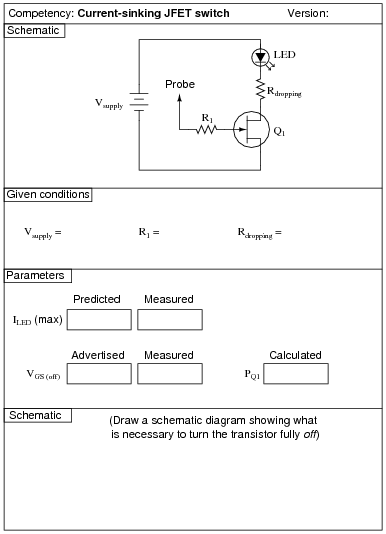
Notes:I strongly recommend a value for R1 of 1 MΩ or more, to protect the JFET gate from overcurrent damage. The students will calculate their own dropping resistor value, based on the supply voltage and the LED ratings.
This exercise lends itself to experimentation with static electricity. The input impedance of an average JFET is so high that the LED may be made to turn on and off with just a touch of the probe wire to a charged object (such as a person).
Using only the components shown, students may not be able to get their JFETs to completely turn off. This is left for them as a challenge to figure out!
I expect students to be able to figure out how to calculate the transistor’s power dissipation without being told what measurements to take!
-
Question 44 of 62
Reveal answerUse circuit simulation software to verify your predicted and measured parameter values.
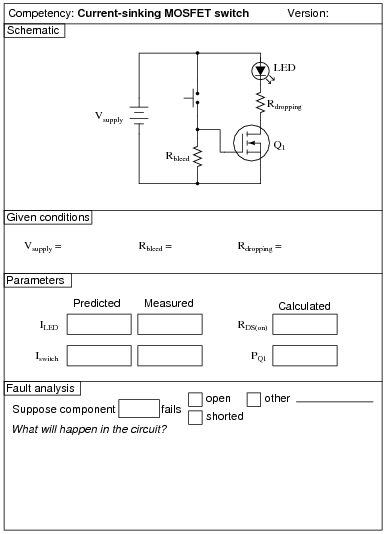
Notes:I recommend a value for R1 of 1 MΩ or more, to show that the bleed resistor need not be very conductive to do its job well. The students will calculate their own dropping resistor value, based on the supply voltage and the LED ratings.
Students predict the LED current (approximately 20 mA) and the switch current (0 mA), and then calculate the transistor’s “on” channel resistance and power dissipation after taking additional measurements. I expect students to be able to figure out how to calculate both these parameters without being told what measurements to take!
-
Question 45 of 62
Reveal answerUse circuit simulation software to verify your predicted and measured parameter values.
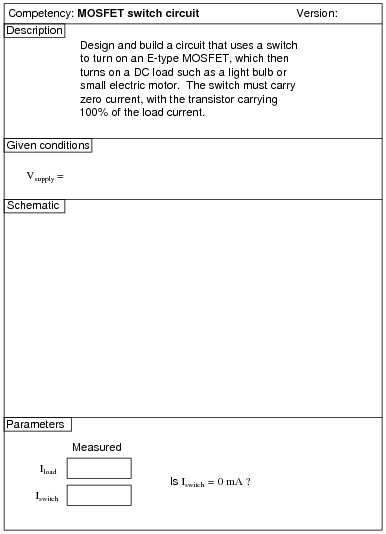
Notes:Being able to design a circuit using a MOSFET as a switch is a valuable skill for technicians and engineers alike to have.
An extension of this exercise is to incorporate troubleshooting questions. Whether using this exercise as a performance assessment or simply as a concept-building lab, you might want to follow up your students’ results by asking them to predict the consequences of certain circuit faults.