Facebook
 Google
 GitHub
 Linkedin
Discrete Semiconductor Devices and Circuits
Performance-Based Assessments for Semiconductor Circuit Competencies
62 questions By Tony R. Kuphaldt
-
Question 58 of 62
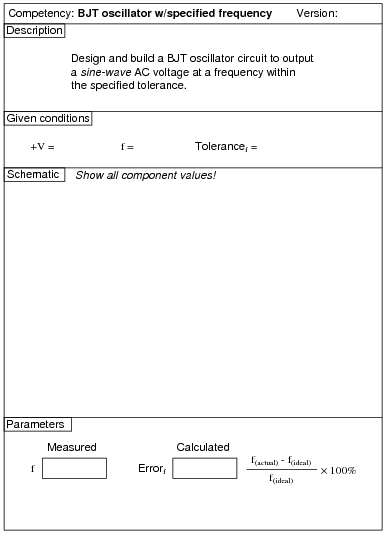
Reveal answerUse circuit simulation software to verify your predicted and measured parameter values.
Notes:Students are free to choose any oscillator design that meets the criteria: sinusoidal output at a specified frequency.
An extension of this exercise is to incorporate troubleshooting questions. Whether using this exercise as a performance assessment or simply as a concept-building lab, you might want to follow up your students’ results by asking them to predict the consequences of certain circuit faults.
-
Question 59 of 62

Reveal answerContrary to what you might think, the datasheet or cross-reference is not the “final authority” for checking your meter-based conclusions! I have seen datasheets and cross-reference manuals wrong more than once!
Notes:Identification of SCR terminals is a very important skill for technicians to have. Most modern multimeters have a diode check feature which may be used to positively identify PN junction polarities, and this is what I recommend students use for identifying SCR terminals.
This exercise may be made even more interesting if students must differentiate between SCR’s with sensitive gates versus SCR’s without sensitive gates!
To make this a really good performance assessment, you might want to take several SCR’s and scratch the identifying labels off, so students cannot refer to memory for pin identification. Label these thyristors with your own numbers (“1”, “2”, etc.) so you will know which is which, but not the students!
-
Question 60 of 62
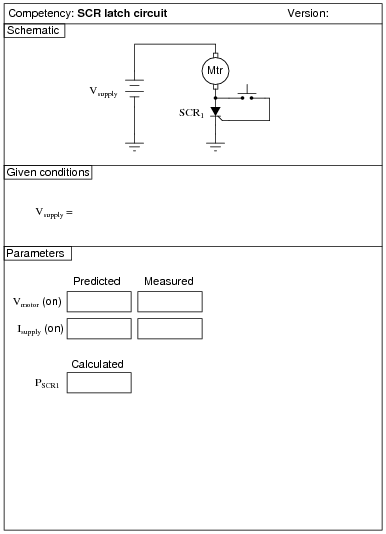
Reveal answerUse circuit simulation software to verify your predicted and measured parameter values.
Notes:I have had good success using 12 volts DC for the supply voltage, an MCR8SN silicon-controlled rectifier, and a small brushless DC fan motor (80 mA running current) as the load. The MCR8SN is a “sensitive gate” SCR, which makes it easy to demonstrate static triggering (just touch the gate terminal with your finger to start the motor!). Some SCR’s may be difficult to keep latched with low-current loads, so be sure to prototype your SCR/load combination before assigning part numbers to your students!
An extension of this exercise is to incorporate troubleshooting questions. Whether using this exercise as a performance assessment or simply as a concept-building lab, you might want to follow up your students’ results by asking them to predict the consequences of certain circuit faults.