Facebook
 Google
 GitHub
 Linkedin
Discrete Semiconductor Devices and Circuits
Performance-Based Assessments for Semiconductor Circuit Competencies
62 questions By Tony R. Kuphaldt
-
Question 22 of 62
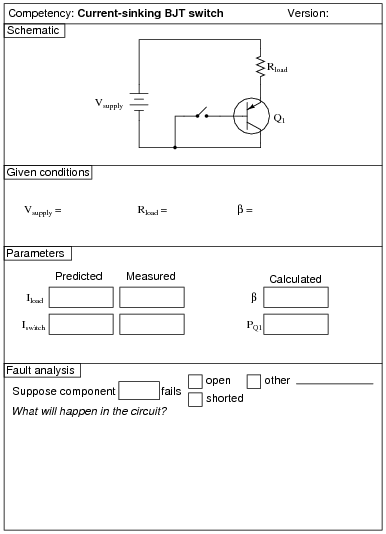
Reveal answerUse circuit simulation software to verify your predicted and measured parameter values.
Notes:Being able to design a circuit using a BJT as a switch is a valuable skill for technicians and engineers alike to have. The circuit shown in this question is not the only possibility, but it is the simplest.
Remind your students that the equation for calculating BJT power dissipation is as follows:
$$P_Q = I_C(V_{CE} + \frac{V_{BE}}{\beta})$$
An extension of this exercise is to incorporate troubleshooting questions. Whether using this exercise as a performance assessment or simply as a concept-building lab, you might want to follow up your students’ results by asking them to predict the consequences of certain circuit faults.
-
Question 23 of 62
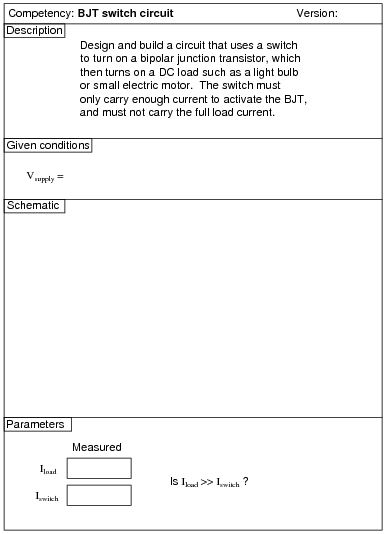
Reveal answerUse circuit simulation software to verify your predicted and measured parameter values.
Notes:Being able to design a circuit using a BJT as a switch is a valuable skill for technicians and engineers alike to have.
An extension of this exercise is to incorporate troubleshooting questions. Whether using this exercise as a performance assessment or simply as a concept-building lab, you might want to follow up your students’ results by asking them to predict the consequences of certain circuit faults.
-
Question 24 of 62
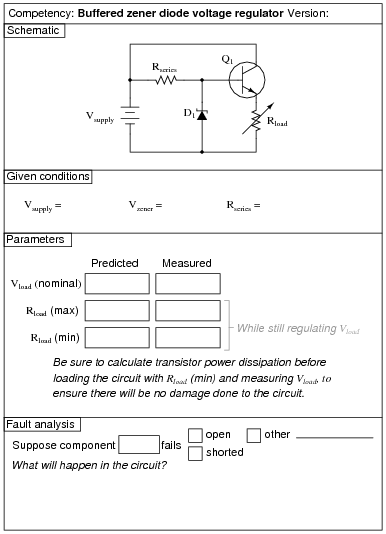
The Rload (max) and Rload (min) parameters are the maximum and minimum resistance settings that Rload may be adjusted to with the regulator circuit maintaining constant load voltage. Vload (nominal) is simply the regulated voltage output of the circuit under normal conditions.
Reveal answerUse circuit simulation software to verify your predicted and measured parameter values.
Notes:Use a variable-voltage, regulated power supply to supply any amount of DC voltage below 30 volts.
I highly recommend specifying a large value for Rseries and/or a high-wattage rated transistor and variable load resistor, so that students do not dissipate excessive power at either the transistor or the load as they test for Rload (min). Do not use a decade resistance box for Rload unless you have made sure its power dissipation will not be exceeded under any circuit condition!
An extension of this exercise is to incorporate troubleshooting questions. Whether using this exercise as a performance assessment or simply as a concept-building lab, you might want to follow up your students’ results by asking them to predict the consequences of certain circuit faults.