Facebook
 Google
 GitHub
 Linkedin
Discrete Semiconductor Devices and Circuits
Performance-Based Assessments for Semiconductor Circuit Competencies
62 questions By Tony R. Kuphaldt
-
Question 37 of 62

Reveal answerUse circuit simulation software to verify your predicted and measured parameter values.
Notes:Use a variable-voltage, regulated power supply to supply a DC voltage safely below the maximum rating of the electret microphone (typically 10 volts). Specify standard resistor values, all between 1 kΩ and 100 kΩ (1k5, 2k2, 2k7, 3k3, 4k7, 5k1, 6k8, 10k, 22k, 33k, 39k 47k, 68k, etc.). Use a sine-wave function generator to supply an audio-frequency input signal, and make sure its amplitude isn’t set so high that the amplifier clips.
I have had good success using the following values:
- VCC = 6 volts
- R1 = 68 kΩ
- R2 = 33 kΩ
- R3 = 4.7 kΩ
- R4 = 1.5 kΩ
- R5 = R6 = 10 kΩ
- R7 = R8 = 10 Ω
- C1 = C2 = 0.47 μF
- C3 = C4 = 47 μF
- C5 = 1000 μF
- C6 = 100 μF
- D1 = D2 = part number 1N4001
- Q1 = part number 2N2222
- Q2 = part number 2N2222
- Q3 = part number 2N2907
An extension of this exercise is to incorporate troubleshooting questions. Whether using this exercise as a performance assessment or simply as a concept-building lab, you might want to follow up your students’ results by asking them to predict the consequences of certain circuit faults.
-
Question 38 of 62
Reveal answerUse circuit simulation software to verify your predicted and measured parameter values.
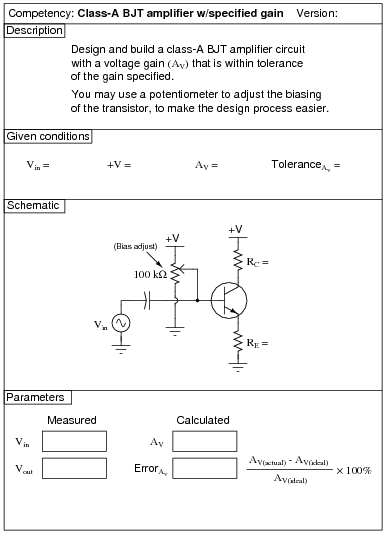
Notes:Students are allowed to adjust the bias potentiometer to achieve class-A operation after calculating and inserting the resistance values RC and RE. However, they are not allowed to change either RC or RE once the circuit is powered and tested, lest they achieve the specified gain through trial-and-error!
A good percentage tolerance for gain is /- 10%. The lower you set the target gain, the more accuracy you may expect out of your students’ circuits. I usually select random values of voltage gain between 2 and 10, and I strongly recommend that students choose resistor values between 1 kΩ and 100 kΩ. Resistor values much lower than 1 kΩ lead to excessive quiescent currents, which may cause accuracy problems (r′e drifting due to temperature effects).
An extension of this exercise is to incorporate troubleshooting questions. Whether using this exercise as a performance assessment or simply as a concept-building lab, you might want to follow up your students’ results by asking them to predict the consequences of certain circuit faults.
-
Question 39 of 62
Reveal answerUse circuit simulation software to verify your predicted and measured parameter values.
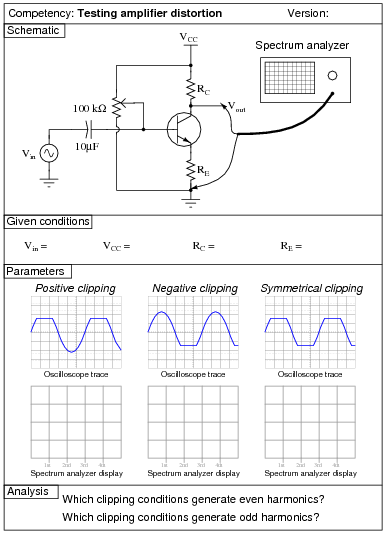
Notes:Use a variable-voltage, regulated power supply to supply any amount of DC voltage below 30 volts. Specify standard resistor values, all between 1 kΩ and 100 kΩ (1k5, 2k2, 2k7, 3k3, 4k7, 5k1, 6k8, 10k, 22k, 33k, 39k 47k, 68k, etc.). Use a sine-wave function generator to supply an audio-frequency input signal.
If you lack a spectrum analyzer in your lab, fear not! There are free software packages in existence allowing you to use the audio input of a personal computer’s sound card as a (limited) spectrum analyzer and oscilloscope! You may find some of these packages by searching on the Internet. One that I’ve used (2002) successfully in my own class is called WinScope.
An extension of this exercise is to incorporate troubleshooting questions. Whether using this exercise as a performance assessment or simply as a concept-building lab, you might want to follow up your students’ results by asking them to predict the consequences of certain circuit faults.