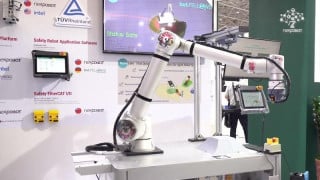
Late-stage safety reviews often expose MCU and firmware gaps that force board re-spins. Building safety into the architecture early changes how a design reaches…
Late-stage safety reviews often expose MCU and firmware gaps that force board re-spins. Building safety into the architecture early changes how a design reaches certification.

Winbond TrustME® W77Q Secure Flash enhances existing memory architectures with minimal redesign while providing SESIP…
Winbond TrustME® W77Q Secure Flash enhances existing memory architectures with minimal redesign while providing SESIP Level 2-certified security capabilities to support product security assessments and CRA readiness, subject to proper configuration, system integration, and certificate scope.

The use case dives into the integrating challenges when OEM develops a connected self-service dispensing equipment.…
The use case dives into the integrating challenges when OEM develops a connected self-service dispensing equipment. Discover how ADLINK's SP2 open-frame panel PC, flexible hardware configurations, and responsive engineering support help equipment developers streamline design-in and meet application-specific requirements.

Discover how ODM expertise can simplify development, cut costs, and accelerate time to market for smarter, more secure IoT panels.
Discover how ODM expertise can simplify development, cut costs, and accelerate time to market for smarter, more secure IoT panels.

Running out of board space? Adam Tech’s ESMC Signal Series delivers high-density connectivity in a compact 1.27mm…
Running out of board space? Adam Tech’s ESMC Signal Series delivers high-density connectivity in a compact 1.27mm pitch, with 2 to 80 positions, flexible board-to-board configurations and matching cable assemblies. Download the application note from Adam Tech to find the right fit for your design.

Artificial intelligence has moved from perception and content generation toward systems that can reason, plan and act.
Artificial intelligence has moved from perception and content generation toward systems that can reason, plan and act.

An isolation barrier failure can take down your system and endanger operators. NOVOSENSE’s application note covers the…
An isolation barrier failure can take down your system and endanger operators. NOVOSENSE’s application note covers the two key failure modes in capacitive isolators and how to design against them, so download it now to build safer, more reliable systems.

Discover how Cadence helps simplify the path to production-ready Physical AI systems while reducing design complexity,…
Discover how Cadence helps simplify the path to production-ready Physical AI systems while reducing design complexity, risk, and time to market.

Radar is the key technology behind ADAS and autonomous driving, from basic object detection to 360° recognition. This…
Radar is the key technology behind ADAS and autonomous driving, from basic object detection to 360° recognition. This poster compares radar types and maps the R&S test solutions for every stage from R&D to production.

Hardware-in-the-Loop testing bridges the gap between simulation and costly road tests for automotive radar. Learn how the…
Hardware-in-the-Loop testing bridges the gap between simulation and costly road tests for automotive radar. Learn how the R&S®AREG800A and R&S®QAT100 enable realistic, repeatable closed-loop validation.

Optimize space requirements management. Learn how to modernize workflows, improve traceability, and prevent failures in…
Optimize space requirements management. Learn how to modernize workflows, improve traceability, and prevent failures in fast‑moving space engineering.

Choosing the right inductor configuration can make a difference in power supply design. Discover practical insights to…
Choosing the right inductor configuration can make a difference in power supply design. Discover practical insights to help optimize your next SEPIC converter.

This white paper provides insight into the technical foundations, standards evolution and test and measurement equipment…
This white paper provides insight into the technical foundations, standards evolution and test and measurement equipment needed to turn 5G NTN capabilities into reliable, scalable services.

This white paper provides an introduction to parasitics & illustrates how parasitics can impact passive components like…
This white paper provides an introduction to parasitics & illustrates how parasitics can impact passive components like capacitors, inductors, and resistors. Learn more about the LCR meter and how it is an excellent tool for this characterization.

RF frontends are becoming increasingly integrated and complex. Discover a practical OTA approach for accurately measuring…
RF frontends are becoming increasingly integrated and complex. Discover a practical OTA approach for accurately measuring group delay in frequency-converting RF frontends for satellite links.

Discover how Melexis encoder technologies enable precise, real-time motion control for advanced robotic systems. Learn…
Discover how Melexis encoder technologies enable precise, real-time motion control for advanced robotic systems. Learn how developers are reducing design complexity while accelerating innovation across emerging robotics applications.

High-frequency current measurements are only as accurate as the sensing element allows. Discover how ultra-low ESL shunt…
High-frequency current measurements are only as accurate as the sensing element allows. Discover how ultra-low ESL shunt designs minimize measurement intrusion and improve visibility into circuit behavior.

Embedded FPGA (eFPGA) is a block of reprogrammable logic built directly into an ASIC or SoC, so part of the chip’s…
Embedded FPGA (eFPGA) is a block of reprogrammable logic built directly into an ASIC or SoC, so part of the chip’s hardware can be changed after it is manufactured. It has moved from an architectural luxury to a standard building block.

Embedded FPGA (eFPGA) puts a block of programmable logic on the same die as an automotive SoC's CPU, memory, and analog,…
Embedded FPGA (eFPGA) puts a block of programmable logic on the same die as an automotive SoC's CPU, memory, and analog, so hardware accelerators needed for radar, battery management, motor control, and security can be updated in the field with a secure bitstream instead of a year-long, multimillion-dollar respin and requalification of the silicon. Here's where it pays for its area, and where it doesn't.

Discover how NXP and Silex Technology help manufacturers address cybersecurity, functional safety, and wireless…
Discover how NXP and Silex Technology help manufacturers address cybersecurity, functional safety, and wireless connectivity challenges in medical and industrial applications. Download the whitepaper to explore the standards, technologies, and design considerations for building secure, safety-ready, and connected embedded systems.


 Facebook
 Google
 GitHub
 Linkedin
